 Xavier Radio Ug News 24 7
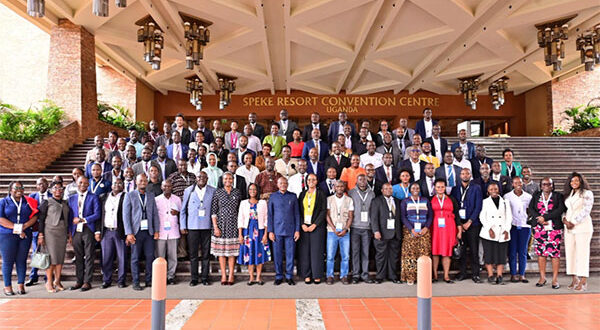
State Minister, General Wilson Mbasu Mbadi (middle) and delegates
Kampala, Uganda | THE INDEPENDENT | The government is set to revise its Trade Policy and Export Development Strategy (NEDS) to accelerate export growth, strengthen industrialization, and position the country more competitively in regional and global markets.
Speaking at a two-day National Trade Review Conference in Munyonyo, Francis Mwebesa, Minister of Trade, Industry and Cooperatives, said the updated policy framework aligns Uganda’s trade agenda with emerging regional and global economic realities while unlocking new opportunities for exporters and manufacturers.
“The revised National Trade Policy focuses on deliberate reforms aimed at increasing Uganda’s participation in international trade,” Mwebesa said, highlighting key priorities such as promoting value addition, diversifying exports, improving compliance with international standards, and strengthening trade facilitation systems.
The policy also emphasizes the growing importance of digital trade, deeper industrial linkages, and integrating micro, small, and medium enterprises (MSMEs) into regional and global value chains.
Complementing the policy, NEDS translates these ambitions into concrete actions. The strategy identifies priority export products and services, strengthens trade promotion and market intelligence, and supports exporters in meeting international quality standards.
It also aims to shift Uganda away from exporting primarily raw commodities toward processed, high-value goods and tradable services.
Wamkele Mene, Secretary-General of the African Continental Free Trade Area (AfCFTA), noted that African countries often face limited fiscal space to fund large investments for economic reforms.
He emphasized the role of African development finance institutions, such as the African Development Bank and the African Finance Corporation, in supporting industrial development, infrastructure, and investment markets across the continent.
Uganda is currently undergoing a national review under the AfCFTA Implementation Review Mechanism, a structured tool to assess how effectively member states are translating treaty commitments into practical market access.
The mechanism evaluates regulatory systems, institutional arrangements, operational practices, and market conditions affecting trade.
Ann Nambooze, Country Director for Uganda and South Sudan at TradeMark Africa, said collaboration between government, the private sector, and civil society is essential to harness Uganda’s comparative advantages and improve livelihoods.
She noted that trade is central to development, particularly through agro-industrialization, tourism, minerals, and science and technology.
Nambooze warned that many Ugandan commodities are rejected in international markets due to failure to meet quality and safety standards, including pesticide use, post-harvest handling, storage, and packaging.
She also highlighted the impact of non-tariff barriers in East Africa, noting that they cost African economies an estimated $9 billion annually due to trade delays and lost opportunities.
She cited Uganda’s sugar exports as an example, where the country exported only $1.5 million to Kenya last year despite a surplus, while Kenya imported over $413 million of sugar from Brazil.
Rising global oil prices and fluctuations in the US dollar also increase import costs, potentially raising consumer prices. To mitigate these shocks, Nambooze called for stronger regional value chains to source more inputs from within Africa.
Meanwhile, State Minister, General Wilson Mbasu Mbadi said the National Trade Review Conference helps the country assess trade performance and develop medium- and short-term actions to improve policy, regulatory, and structural reforms aimed at boosting exports and value addition.
Prudence Busingye, Founder and CEO of K-ROMA Ltd, noted that while Uganda produces high-quality products that can compete internationally, government support for manufacturers—financial assistance and international promotion- is insufficient.
In response, General Mbadi said the government is working to reduce electricity costs for manufacturers, facilitate access to affordable funding through the Uganda Development Bank, address non-tariff barriers, diversify markets, and promote greater value addition along the value chain.
The revised trade policy and export strategy signal Uganda’s commitment to creating an environment that supports industrial growth, increases exports, and strengthens the country’s position in regional and global markets.
****
URN
www.independent.co.ug, https://www.independent.co.ug/govt-revises-trade-policy-and-national-export-strategy/