 Xavier Radio Ug News 24 7
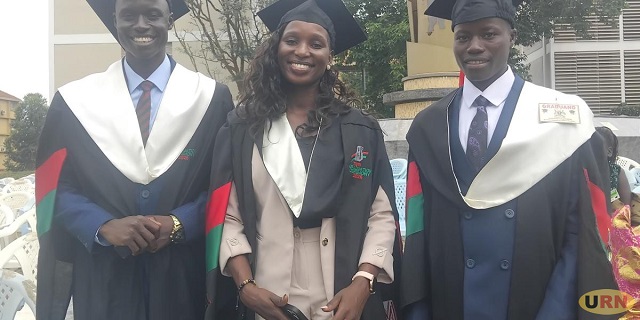
Robert Opwanya (L), Sarah (best female student) and Robert’s brother after graduation at Makerere.
Kampala, Uganda | THE INDEPENDENT | More than half of the students who enroll in postgraduate programs at Makerere University, the “Journey to Freedom Square” ends not in the triumph of a graduation gown, but in a long, grueling stalemate.
Despite the prestige of Uganda’s premier institution, recent data reveal a burgeoning crisis where thousands of Master’s and PhD candidates fail to complete their studies within the stipulated timelines, trapped between systemic inefficiency and personal hardship.
A series of alarming audit reports from the Office of the Auditor General (OAG) has cast a harsh spotlight on this breakdown.
The most recent 2025 report, presented to Parliament by Edward Akol, highlights “gross research incompetence” and operational inefficiency across public universities.
At Makerere and its business school (MUBS), the backlog has reached a tipping point; over 1,240 graduate students failed to graduate in the last decade.
While a Master’s degree is accredited for two years, the OAG found many students taking six, seven, or even ten years to finish.
The statistics are stark: nearly 37% of Master’s students enrolled between 2013 and 2021 remain in the system, while the PhD completion rate sits at a dismal 31.5% within the audit window.
The human cost of these delays is perhaps best illustrated by the Journalism and Mass Communication Master’s class of 2020. Of the 28 students who began the journey, only two managed to graduate by 2024, with another two following in 2025.
With only three in the ongoing 76th graduation cycle, more than 20 students from that single cohort remain in academic limbo.
The Auditor General identifies “delayed supervision” as the primary culprit, fueled by a staggering human resource gap.
Makerere is currently operating at just 39.63% of its required academic staffing level. With less than half of the necessary lecturers available, the existing staff is overwhelmed; many researchers are juggling more than four concurrent projects, leaving students waiting months or years for feedback on their manuscripts.
Despite these hurdles, some navigate the broken system through early intervention. Dr. Jimmy Osuret, who recently defended his PhD in Public Health, stands as a rare success story.
His research on pedestrian road safety for school children was completed by January 2025 because he began his manuscripts early and maintained a rigorous timeline.
However, he acknowledges his experience is the exception. While the “normal” path should be three to four years, he notes that many of his peers spend a decade simply trying to get a proposal approved.
For many, the transition from coursework to research is the ultimate “stumbling block.” Robert Opwanya, a Master’s student in Procurement and Supply Chain Management, observed that only seven out of fifty students in his cohort graduated on time.
He notes that while students excel in the classroom, the independent nature of research demands a technical mastery of methodology that many find overwhelming.
This is frequently compounded by “supervisory frustration,” where conflicting feedback from different supervisors or a lack of communication skills leaves a student stagnant.
Opwanya has witnessed individuals who started in 2009 only just reaching the graduation square today, having survived not only academic friction but the physical toll of fieldwork and uncooperative respondents.
Beyond the gates of the university, social and financial pressures decimate entire classes. Emily, an MBA graduate, recalls her program beginning with 830 students, whittled down to just 120 by graduation.
She describes a “triple burden” shared by the majority of her peers: balancing the roles of employee, spouse, and student.
Emily adds that for many, the “storm” is financial. “After the first semester, students are often forced to choose between their own tuition and their children’s school fees. Even when supervisors are available, they operate on a “queue system.”
These high-level academics manage massive backlogs, and if a student shows any sign of laxity, they are quickly bypassed.
In the end, graduating from Makerere is often less a test of intelligence and more a test of resilience, the ability to be one’s own cheerleader when work, family, and a strained academic system conspire to halt progress.
****
URN
www.independent.co.ug, https://www.independent.co.ug/journey-to-freedom-square-resilience-amidst-makereres-institutional-crisis/