 Xavier Radio Ug News 24 7
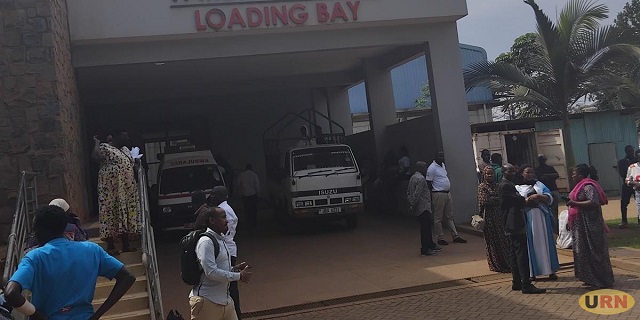
Mulago Hospital Mortuary.
Kampala, Uganda | THE INDEPENDENT | It is a place where silence should reign, but at the Mulago National Referral Hospital mortuary, the air is more often filled with the sounds of impatient shouting, wailing, and the heavy toll of bureaucracy.
While the facility sits quietly opposite the Kampala City Mortuary, the scene on Thursday morning was anything but calm. For many families, the grief of losing a loved one is compounded by a “battle” to navigate the lengthy, and sometimes costly, processes required to take their dead home for burial.
The atmosphere shifted sharply on Thursday when a Canter truck (Reg. No. UBA 0321) arrived from Seeta. Unlike the typical mourners who arrive draped in somber distress, this group of young men was charged with anger.
Some were shirtless, shouting and pacing restlessly as they demanded the body of their friend, who had reportedly died following an accident a week prior.
The morgue, a facility designed for the quiet transition of the departed, nearly spiraled into chaos as the group waited over two hours for clearance.
When the body was finally released, there was no casket; the deceased was wrapped in a simple white bedsheet and bundled into the back of the truck.
The anger of the youth transitioned into piercing wails as they drove away, exhausted by the delay.
For those without a vocal or aggressive crowd, the wait is often even longer. One family from Eastern Uganda reported waiting over three hours upon arrival, despite their mother having been in the morgue for almost a week.
Speaking on condition of anonymity, the family revealed the hidden costs of ensuring a loved one is treated with dignity.
“There are so many corpses here,” the son explained. “If you don’t keep in touch with the team, they ignore your relative, and the bodies might rot. We paid a daily charge of 20,000 shillings just to ensure mama was well-kept while we mobilized resources for the funeral.”
The administrative hurdle is a mix of official “protocol” and unofficial “connections.” Ismael, who came from Seeta to pick up his brother, Lulebe Nuhu, described a rigid system of signing books, waiting for doctors, and bank payments.
Lulebe, a Muslim, died around midday on Wednesday after suffering a stroke shortly after being readmitted to Ward 4B. For his family, the need for a quick burial was paramount, yet they still faced the mandatory post-mortem process.
“Sometimes it delays,” Ismael admitted. “If you don’t know somebody here, it delays. For us, we have a brother who is a doctor here, so we went through smoothly. But you still have to follow the protocol; sign the book, wait for the post-mortem, and get the letter stating the cause of death.”
Paradoxically, a notice hangs at the reception stating that “underprivileged Ugandans” can access all services at no cost, provided they receive clearance from hospital administration. However, obtaining clarity on these processes proved futile.
Hospital officials redirected our reporter in a continuous loop from the mortuary front desk to pathologists, the public relations office, and the offices of the Executive Director, all to no avail.
Dr. Sam Kalungi, head of pathologists at Mulago Hospital, maintains that all services at the mortuary are free of charge.
When asked whether a post-mortem is mandatory for all bodies, Dr. Kalungi declined to comment, stating it is a policy matter that can only be addressed by the Executive Director.
However, a retired, long-serving police detective who worked at the City Mortuary offered a more candid explanation for the “hidden” fees.
He noted that money often changes hands when there is a shortage of supplies, specifically formalin for preservation.
He added that all bodies in the mortuary are subjected to a post-mortem for investigations to rule out death from suspicious health conditions that would otherwise affect others, in case they were contagious.
“It is only a postmortem report that helps the family access the property of the deceased person in court or NSSF money. It is in the postmortem where you find the cause of the death,” he said.
According to the source, some staff take advantage of these shortages to “survive” in the unit, negotiating amounts with relatives to ensure bodies are preserved.
****
URN
www.independent.co.ug, https://www.independent.co.ug/the-grueling-battle-to-claim-for-the-dead-at-mulago-mortuary/