 Xavier Radio Ug News 24 7
By Lehumo Sejaphala
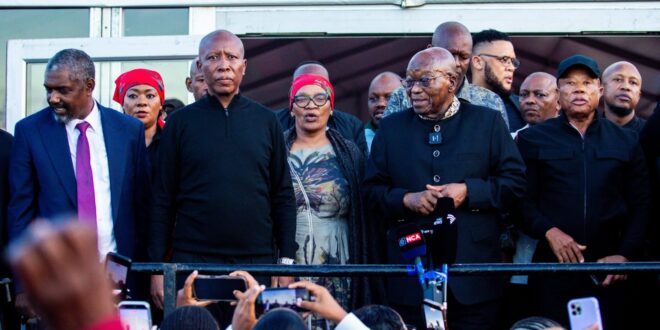
When former President Jacob Zuma visited the family of Julius Malema to offer condolences following the death of Malema’s maternal aunt, the Economic Freedom Fighters, true to form, issued a statement describing the gesture as an act of “political maturity.” The implication was clear: that, at least momentarily, politics had been set aside in favour of human solidarity.
This claim is both comforting and misleading. It rests on a fiction that political actors can step outside politics at will. In reality, the conduct of public figures is never insulated from political meaning. Even their most personal gestures are mediated through the logic of power, perception, and strategic positioning.
The Italian philosopher, Niccolò Machiavelli, offers a useful starting point. In The Prince, he underscores the importance of appearances in the exercise of power. A ruler, he argues, must learn how “not to be good,” but must always appear virtuous. Acts of compassion, generosity, or humility are never merely moral; they are instruments through which authority is maintained and legitimacy is cultivated. What matters is not only what a political actor does, but how that act is seen.
Zuma’s visit, whether motivated by genuine sympathy or not, cannot escape this logic. It communicates something to the public. It softens the memory of past antagonisms, recasts relationships, and signals a form of openness. In Machiavellian terms, it is a performance of virtue, one that carries political utility regardless of its sincerity.
The analysis deepens when one turns to the French sociologist, Pierre Bourdieu’s concept of symbolic capital, which refers to the accumulation of honour, recognition, and legitimacy that actors deploy within a social field. Put in context, Zuma’s gesture of empathy is not neutral; it is an investment in symbolic capital. It enhances his credibility, reshaping his reputation, and may ultimately expand his base of appeal.
Viewed through this lens, the visit becomes a strategic act within the political field rather than an escape from it. It allows both actors to recalibrate their public images. For Zuma, it may signal magnanimity and continued relevance. For Malema, it may project maturity and leadership beyond partisan hostility. For both, it opens interpretive space among supporters who may be receptive to a less antagonistic posture.
The point is not to deny the possibility of genuine human feeling. It is entirely plausible that Zuma’s visit was, at least in part, an expression of personal condolence. But in politics, intent does not exhaust meaning. Public acts are never received in their purity; they are interpreted, contested, and absorbed into broader narratives of power.
This is particularly true in South Africa, where political identities are deeply embedded in histories of struggle, betrayal, and factional realignment. The relationship between the Economic Freedom Fighters and the uMkhonto weSizwe Party is not simply interpersonal. It is structured by competing claims to legitimacy, overlapping constituencies, and the enduring influence of Zuma himself. In such a context, even gestures of mourning are politically saturated.
To describe the visit as “above politics” is, therefore, not an act of description, but of narrative construction. It invites the public to suspend critical scrutiny and to accept a temporary depoliticisation of an inherently political act. Yet this suspension is neither analytically sound nor empirically sustainable.
A more honest account would recognise the dual character of the gesture. It may be personally sincere, but it is unavoidably political in its meaning and effect. Politicians do not cease to be political because the occasion is solemn. On the contrary, it is precisely in such moments that symbolic acts carry heightened significance.
The language of “putting aside political differences” thus obscures more than it reveals. It suggests a clean separation between the personal and the political that does not exist in public life. As Machiavelli reminds us, appearances are central to power. And as Bourdieu shows, symbols are a form of capital. Between these insights lies a simple truth: in politics, there is no outside.
Zuma’s visit should not be read as a departure from politics, but as a continuation of it by other means.– By Lehumo Sejaphala (X: @Masterndozi)
www.sabcnews.com, https://www.sabcnews.com/sabcnews/comment-public-grief-private-strategy-politics-behind-zumas-visit/