 Xavier Radio Ug News 24 7
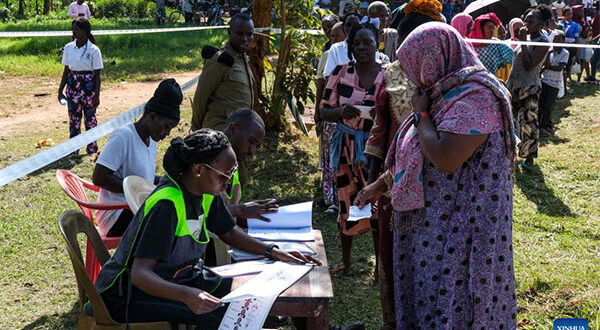
People line up to collect ballot papers at a polling station in Wakiso district, Uganda, on Jan. 15, 2026. (Photo by Mary Kansiime/Xinhua)
Brussels, Belgium | THE INDEPENDENT | The European Parliament has stepped up scrutiny of Uganda’s political path after the disputed January 15, 2026, elections, issuing a resolution condemning post-election violence and expressing concern over threats to opposition leaders and civil society actors. At the Delegation to the African–EU Parliamentary Assembly (DAFR) ordinary session in Brussels on Monday, chaired by Belgian MEP Hilde Vautmans, lawmakers reaffirmed Uganda as a “key partner” in regional peace and security, but underscored that adherence to democratic principles and human rights remains “non-negotiable.”
The debate follows a February 12 resolution passed by an overwhelming majority, 514 votes in favour, three against, and 56 abstentions, expressing “serious concerns” over the conduct and aftermath of Uganda’s 2026 polls. Uganda remains central to European strategic interests in East Africa.
It is one of the largest troop-contributing countries to the African Union peace support mission in Somalia and hosts more than 1.5 million refugees, mainly from South Sudan and the Democratic Republic of Congo, according to UN figures, making it Africa’s largest refugee-hosting nation.
“Uganda is a very important partner for Europe in terms of regional peace and security,” Vautmans told the committee. “At the same time, our commitment to human rights and fundamental freedoms is non-negotiable. We will not shy away from difficult conversations.”
EU lawmakers linked their engagement to the spirit of the Samoa Agreement, the post-Cotonou framework guiding relations between the EU and African, Caribbean, and Pacific states, which emphasizes governance, accountability, and human rights. Appearing remotely before the Parliament, opposition leader Robert Kyagulanyi Ssentamu, widely known as Bobi Wine and head of the National Unity Platform (NUP), alleged widespread repression before, during, and after the vote.
“What happened on the 15th of January was not an election. It was a military operation,” Kyagulanyi said, claiming that security forces raided his home days after the vote and that his family was assaulted. He described himself as “in hiding” due to ongoing threats.
Kyagulanyi accused the Electoral Commission, chaired by Justice Simon Byabakama, of failing to transparently publish declaration of results forms as required by law, arguing that official tallies differed from records gathered by his party agents. He said the opposition declined to challenge the results in court because it had “no confidence” in the judiciary’s independence.
Uganda’s government through the Ministry of ICT and National Guidance, headed by Dr. Chris Baryomunsi, has consistently defended the credibility of its electoral processes, maintaining that voting was largely peaceful and conducted in accordance with national law. The Electoral Commission previously stated that results reflected the will of the people and that legal avenues for redress remained open to aggrieved parties.
Also addressing lawmakers was Sarah Bireete, Executive Director of the Centre for Constitutional Governance (CCG) and a regional election observer. She detailed her late-December arrest, alleging unlawful detention, denial of legal access, confiscation of devices, and digital impersonation.
“I was profiled as a dangerous person for promoting democracy and human rights,” she told the Parliament, arguing that the suspension of several governance-focused NGOs violated Uganda’s NGO Act and constitutional guarantees.
Uganda’s Constitution guarantees rights to due process, legal representation, and freedom of association. However, rights groups have long raised concerns about shrinking civic space, particularly during electoral cycles. Responding to the resolution, European External Action Service official Jonas Jonsson reaffirmed that the EU had acknowledged the election results in a January 23 statement while expressing regret over post-election violence and threats against opposition actors.
“Our observations acknowledged largely peaceful voting, while highlighting concerns related to the political playing field, arrests of opposition actors, and restrictions affecting access to information,” Jonsson said.
He emphasized that the EU would continue engaging both government and opposition, supporting governance reforms, civic education, and institutional strengthening. Uganda and the EU mark 50 years of diplomatic relations. “The EU remains a predictable and long-term partner supporting Uganda’s democratic journey through dialogue, cooperation, and shared commitment to stability and inclusive governance,” he added.
Kyagulanyi urged the EU to impose targeted sanctions under instruments such as the EU Global Human Rights Sanctions Regime, often referred to as the EU’s version of the Global Magnitsky framework, against officials implicated in alleged abuses. “Targeted sanctions do not hurt the nation; they save it,” he argued, calling for visa bans and asset freezes against specific security and political leaders.
The European Parliament resolution similarly called for independent investigations into alleged human rights violations and for reviewing EU cooperation to ensure alignment with democratic principles.
However, any move toward sanctions would require consensus among EU member states, a decision taken by the Council, not Parliament alone, and would likely weigh broader geopolitical considerations, including Uganda’s regional security role.
The 2026 elections mark another chapter in Uganda’s complex political evolution under President Yoweri Museveni, who has been in power since 1986. Critics argue that constitutional amendments removing presidential age and term limits have entrenched incumbency advantages, while the government insists reforms were legally enacted and reflect parliamentary sovereignty.
For Brussels, the dilemma is balancing principled diplomacy with pragmatic engagement in a volatile region. As Vautmans concluded, “Accountability is a central principle of democracy. As partners, we want to work together to improve the situation of the Ugandan population, but we will not contribute to the silencing of opposition.”
****
URN
www.independent.co.ug, https://www.independent.co.ug/eu-parliament-confronts-uganda-over-2026-election-fallout/