 Xavier Radio Ug News 24 7
Museveni
Robert Lansing Institute for Global Threats and Democracies Studies (RLI) predicted a Museveni win at between 65% and 75%, and that Robert Kyagulanyi Ssentamu would get between 20-30% of the cast votes.
Kampala, Uganda | URN | As Uganda headed to the polls on 15 January 2026 for the presidential and parliamentary elections, a U.S.-based think tank predicted that President Museveni was likely to win the election by between 65 and 75 percent.
According to official results announced by Electoral Commission Chairperson Justice Simon Byabakama, Museveni received 7,946,772 votes (71.65%), while opposition leader Robert Kyagulanyi Ssentamu, popularly known as Bobi Wine, obtained 2,743,190 votes (24.72%).
The outcome closely aligned with forecasts by the U.S.-based Robert Lansing Institute for Global Threats and Democracies Studies (RLI), which had predicted a Museveni win between 65% and 75%.
The study “The Future of Uganda: Political Scenarios Amid Museveni’s Election Challenge” examined the potential political, economic, and social outcomes of Uganda’s 2026 elections under Yoweri Museveni.
It said President Museveni, who has been in power since 1986, entered the election with entrenched institutional advantages, including key pathways such as the incumbency advantage with deep-rooted control over state resources and administrative processes.
It evaluated the implications of either Museveni’s continued rule or his potential electoral defeat. RLI noted: “Museveni’s probability is structural, not popularity-based. It depends on control, not persuasion.” Analysts said that while his core support remains strong in rural areas, it is institutional dominance rather than broad-based popularity that ensures a high likelihood of victory.
RLI also said Museveni had control over the Uganda People’s Defence Force (UPDF), police, intelligence agencies, and administrative leverage with influence over the Electoral Commission and courts to shape electoral processes. “Uganda heads into presidential and parliamentary elections under conditions that strongly favor the incumbent and constrain the opposition’s ability to campaign and mobilize,” it warned.
Museveni, according to RLI, had an added advantage of rural patronage networks through mobilization of loyal voters via local elite and party machinery.
RLI, also pointed out that while there were other candidates in the race, the contest was between Yoweri Museveni and Robert Kyagulanyi (Bobi Wine).
For Kyagulanyi, the think tank said his estimated probability of winning the election was at medium-low, estimated at 20-30%.
The Institute observed that Kyagulanyi enjoyed a strong urban and youth support, but again observed that his path was narrow.
It said he required massive urban and youth turnout, particularly in Kampala, Wakiso, and other cities, and that he needed a cross-regional protest vote through mobilizing beyond the traditional base.
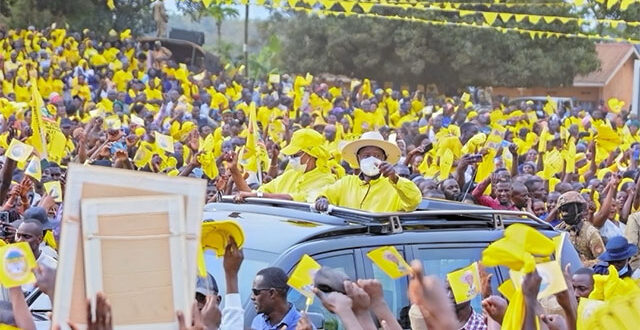
Bobi Wine on the campaign trail
RLI also said Bobi Wine needed an electoral overperformance by winning enough votes to overwhelm the manipulation capacity.
It stated that Kyagulanyi’s win would depend on reduced repression during the campaign, “unlikely under current conditions, effective vote protection at polling stations, neutrality or fragmentation among security elites.”
And it warned of risk factors that could lead to loss. “Violent crackdowns on supporters, arrests of senior NUP figures, and internet or media shutdowns remain major threats to Bobi Wine’s campaign, making success conditional on multiple favourable and unlikely factors.”
The institute said the other candidates had a very low probability (<5%) of winning the election.
“The minor candidates may benefit from elite fragmentation or sudden withdrawal/incapacitation of main contenders; their impact is limited and largely symbolic,” it concluded.
RLI emphasized that while the Electoral Commission had set polling dates and published procedural notices, providing formal certainty, the political environment remained deeply contested.
The institute concluded that the election was heavily skewed in favor of the incumbent due to institutional control and rural networks. It however suggested the urban youth movements remained a significant counterweight, though constrained by security measures. It however added that “Even low-probability extra-institutional outcomes could have major political consequences.”
“Securitization” and Pre-Election Climate
The dominant feature of Uganda’s pre-election period, the RLI noted, was securitization. Restrictions on public assembly and media coverage, along with repeated reports of violent disruption of opposition events, define the electoral landscape.
“Reuters reports a government ban on live broadcasts of riots and ‘unlawful processions’ ahead of the vote—framed as public order policy but criticized as information control,” the RLI briefing stated.
“In practice, this means the election is taking place in a formal electoral framework with limited political competition—a familiar pattern in Uganda’s recent cycles,” RLI observes.
Ethnicity, Patronage, and Political Dynamics
While Ugandan elections are not “purely ethnic,” the RLI briefing noted that ethnicity shapes elections indirectly through regional patronage, historical grievances, and access to state resources.
“Opposition strength is often highest in urban and youth-heavy areas, where identity politics is partly replaced by ‘governance vs. regime’ polarization,” RLI explained.
The institute warned that if the electoral process is perceived as closed, communities may interpret outcomes through a lens of exclusion, increasing the risk of localized tension, even as national control is maintained.
Foreign and Economic Considerations RLI said Uganda’s elections unfolded amid significant regional and economic stakes. Western governments balance human rights advocacy with security cooperation in the Great Lakes region, while Uganda’s imminent commercial oil production—set to begin later in 2026 with companies like TotalEnergies and CNOOC—heightens the strategic importance of political stability.
Bobi Wine has criticized Western partners for continuing engagement with Museveni despite human rights concerns, arguing that interests often outweigh democracy promotion.
RLI outlined three possible outcomes for Uganda’s 2026 elections: Incumbent victory with contested legitimacy (baseline): Museveni wins, the opposition disputes the results, and security forces manage protests. This scenario reinforces institutional control and entrenches perceptions that elections cannot produce change.
It warned of possible protest escalation and violent crackdowns (elevated risk). It suggested that a potential of large-scale demonstrations, particularly in Kampala, could trigger forceful state responses, carrying the highest near-term risk of deaths, mass detentions, and prolonged instability. It suggested a scenario of opposition overperformance but blocked transition (low probability).
“Even if Bobi Wine performs strongly, Uganda has no precedent for a peaceful presidential transition,” RLI said. “This scenario could lead to elite splits, constitutional crises, or coercive containment of opposition results.”
RLI also highlighted a 10–15% risk of extra-institutional outcomes, including mass protests, urban unrest, arrests of opposition leaders, and international condemnation. The institute emphasized that “even low-probability extra-institutional outcomes could have major political consequences.”
It concluded that Uganda’s 2026 elections were best understood as a contest between an entrenched state-party-security system and a mass opposition movement with real popular energy but limited institutional leverage.