 news TRUSTED NEW
Kampala, Uganda — The election of Jacob Marksons Oboth Oboth as Speaker of Uganda’s 12th Parliament is being interpreted by many political observers as more than a routine parliamentary transition. For some, it represents a carefully calibrated consolidation of power within the ruling establishment. For others, it reflects a familiar cycle in Uganda’s politics where loyalty, timing, and silence often carry greater political currency than public ambition.
Oboth Oboth’s ascent comes in the aftermath of one of the most politically turbulent periods in Uganda’s recent parliamentary history: the dramatic fall of former Speaker Anita Annet Among, whose tenure increasingly became overshadowed by allegations of corruption, abuse of office, and widening internal divisions within the state machinery. While no court of law has convicted her on many of the allegations circulating in public discourse, the political pressure surrounding her office had become impossible to ignore.
The turning point, according to analysts, emerged when the ruling establishment appeared to withdraw its political shield. The announcement by Patriotic League of Uganda (PLU) Secretary General Daudi Kabanda distancing support from the outgoing Speaker was widely viewed as a signal of shifting power calculations within the system. What followed intensified speculation: security operatives reportedly conducting searches at properties associated with the former Speaker, including her residence, office, village home, and business-linked establishments.
For Ugandans who have witnessed similar political episodes over the decades, the developments revived uncomfortable memories. Across different administrations and institutions, several once-powerful figures have experienced abrupt political isolation after falling out of favour with the establishment they once served. In Uganda’s political culture, critics argue, humiliation often begins quietly through silence from allies, withdrawal of endorsements, or strategic distancing before formal political collapse becomes visible.
It is within this atmosphere that Oboth Oboth’s rise is being examined, unlike many figures who openly campaigned or positioned themselves for the speakership, Oboth Oboth remained notably restrained. His name rarely dominated public debate around succession politics. Yet behind the scenes, his political journey had been unfolding steadily and methodically through the institutional corridors of Parliament and Cabinet. Representing West Budama Central, Oboth built influence not through populist theatrics, but through committee systems and internal parliamentary structures. He chaired key committees including Rules, Discipline and Privileges; Natural Resources; and Legal and Parliamentary Affairs positions that exposed him to both legislative procedure and power negotiation. His later appointments as State Minister for Defence and subsequently Minister of Defence and Veteran Affairs further deepened his proximity to the centre of state power.
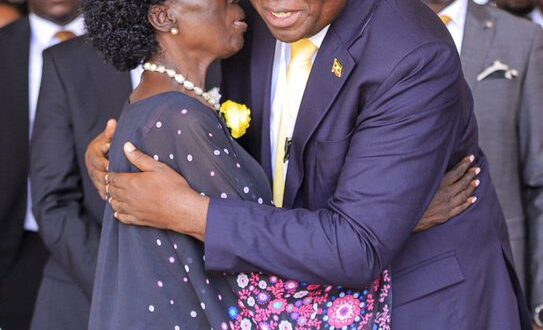
The circulation of photographs showing Oboth alongside former Speaker Rebecca Alitwala Kadaga has only added another layer to political interpretation. Kadaga, who herself experienced a difficult and highly publicized exit from the speakership, was long perceived to have maintained a complicated relationship with Among. For sections of the political class, the imagery symbolized continuity within an older institutional network seeking renewed influence after years of internal contestation.
The central question emerging from the transition is whether Oboth Oboth represents a stabilizing negotiator within the ruling establishment or a consolidator of deeper executive influence over Parliament. Supporters describe him as measured, experienced, and institutionally grounded. They argue that his background in legal and parliamentary affairs positions him to restore procedural discipline and rebuild public confidence in the House after years of controversy and political spectacle. Critics, however, caution that Uganda’s Parliament has historically struggled to maintain full institutional independence from executive power. In their assessment, the speakership transition may signal a broader reorganization of internal political control rather than a democratic reset.
Yet beyond elite political calculations lies a deeper public sentiment, For many Ugandans who have previously watched prominent officials rise, fall, and face state pressure after losing political protection, the latest developments resonate less as isolated events and more as part of a recurring national pattern. It is a reminder of how fragile political alliances can become when power shifts direction.
Still, Oboth Oboth enters office at a defining moment for Uganda’s legislature. Public trust in institutions remains under scrutiny, youth unemployment continues to shape political frustrations, and demands for accountability are growing louder across civic spaces. Whether his leadership becomes remembered as a period of institutional repair or political consolidation may ultimately depend not on how he attained the office, but on how he exercises it. For now, one reality remains undeniable: Jacob Oboth Oboth’s rise was quiet, calculated, and deeply consequential and in Ugandan politics, silence has often been the loudest signal of all.
Post navigation
Source link