 news TRUSTED NEW
They seek ”collective reflection’ and ‘a respectful and constructive dialogue’
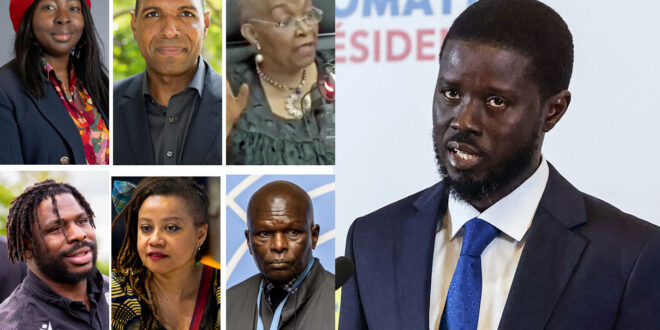
Senegal President Bassirou Diomaye Faye (right) and six of the 30 who sent him the open letter. Clockwise from upper left: Annah Bikouloulou, deputy mayor of Paris; Olivier Serva, member of the National Assembly for Guadeloupe; Alice Nkom of Cameroon, lawyer, member of the UN Permanent Forum on People of African Descent; Doudou Diène of Senegal, former UN Special Rapporteur on new forms of discrimination; Eva Doumbia of France, director and writer; and Jérémy Clamy-Edroux, former professional rugby player, engineer and lecturer. (Photos courtesy of Wikimedia Commons, City of Paris, Instagram, The Guardian of Nigeria, X and Radio France)
Dozens of prominent citizens from Africa and the African diaspora have urged Senegal to suspend its harsh new law increasing the penalties for same-sex relations.
That law has created a climate of fear, violence, and stigmatization targeting LGBTQ+ people: assaults, arrests, family breakdowns, and difficulties accessing healthcare, their open letter states.
Addressed to President Bassirou Diomaye Faye, the letter is signed by lawyers, artists, community leaders, and elected officials from many African countries and the diaspora. In the following excerpts from the letter (translated from French):
They acknowledge Senegal’s sovereignty
“We wish to make this clear: this is not about condemning Senegal, nor about denying its sovereignty, which must be respected. But Senegal is a signatory to the African Charter on Human and Peoples’ Rights and the United Nations Charter, which enshrine, in particular, the right to privacy and the principle of non-discrimination. So why does Senegal refuse to honour its own African and international commitments?”
They praise President Bassirou Diomaye Faye
“When you came to power, your election sparked considerable hope, far beyond the borders of Senegal and the continent. Many saw you as the embodiment of political renewal, that of a new generation, championing the values of justice, dignity and sovereignty. You presented yourself as inspired by a ‘left-wing pan-Africanism’, thereby arousing enthusiasm and expectation among those who aspire to a freer, fairer and more united Africa.”
They deny that homosexuality is ‘unAfrican’
“Some claim that homosexuality is alien to Africa. This idea does not stand up to scrutiny. All African historians and ethnologists know this. In many African languages, including Wolof [the local language in Senegal], terms have long existed to describe realities related to homosexuality, proof that it is neither new nor imported. In Senegal, the goorjigeens had a place in society. What will become of them? On the other hand, the laws that repress them are, for the most part, a legacy of colonisation. Whether it be the French-inspired penal codes or the ‘sodomy laws’ introduced by the British Empire during the reign of Queen Victoria, these provisions were imposed from outside. And the foreign forces pushing Senegal to prosecute homosexual and transgender people, and even to ban any calm debate on the issue, are very diverse.”
They cite the support for their position from celebrated leaders and African nations
“The emancipatory Pan-Africanism that we espouse has been powerfully embodied by major historical figures. Nelson Mandela and Desmond Tutu, both Nobel Peace Prize laureates, consistently fought against discrimination based on sexual orientation. Jesse Jackson, with his Rainbow Coalition, included gay and lesbian people in his struggle for equality. Angela Davis, for her part, has always championed an intersectional view of these struggles, linking the fights against racism, sexism, capitalism and discrimination based on sexual orientation.
“Furthermore, several African countries have recently moved towards greater recognition of rights: Botswana, Mozambique, Gabon and Angola have decriminalised homosexuality in recent years. These choices show that, within Africa itself, there are diverse paths forward, and that no inevitability condemns the continent to repression.”
They seek a moratorium to allow a constructive discussion of the issues it raises
“We are all part of the same pan-African family. And as in any family, disagreements may arise. But it is through discussion, whether under the baobab tree or elsewhere, that these disagreements can be resolved. It is in this spirit that we write to you today.
“We wish to invite the Senegalese authorities to open a respectful and constructive dialogue on these issues. In the meantime, however, we call for a moratorium on arrests and the enforcement of sentences in order to ease tensions and allow for collective reflection. We also hope that the March 2010 law on HIV/AIDS will be respected, particularly Article 12, as testing must be carried out freely and voluntarily, and results must remain confidential.
“Mr President, it is our hope that Senegal will continue to be a beacon for Africa, not only through its political stability, but also through its commitment to human dignity.
“Please accept, Mr President, the assurance of our highest consideration and our pan-African solidarity.”
The full text of the letter, in English and French, is here.
Full list of signatories:
These people signed the letter:
-Alice Nkom [of Cameroon], lawyer, member of the UN Permanent Forum on People of African Descent
-Doudou Diène [of Senegal], former UN Special Rapporteur on new forms of discrimination
-Victorin Lurel, Senator for Guadeloupe, former minister
-Marcelin Nadeau, Member of Parliament for Martinique
-Olivier Serva, Member of the National Assembly for Guadeloupe
-Annah Bikouloulou, Deputy Mayor of Paris, responsible for equality, human rights and the fight against discrimination
-Nouriati Djambae, Member of the Bouches-du-Rhône Departmental Council
-Jean-Jacob Bicep, former Member of the European Parliament, member of the Human Rights Committee
-Dominique Sopo, President of SOS Racisme
-Achille Mbembé, philosopher
-Jean-Claude Barny, filmmaker
-Eva Doumbia [of France], director, writer
-Brian Scott Eagle, founder of the Josephine Baker Museum,
See Also
-Matthieu Niango, essayist, writer
-Brahim Naït-Balk, radio presenter, football coach
-Jo Amaranthe, co-founder of Black Pride
-Fabrice Nguena, human rights defender, author
-Carlos Idibouo, human rights defender
-Félicité Esther Zeifman, barrister at the Paris Bar
-Brice Nzamba, barrister at the Paris Bar
-Nadia Chonville, writer
-Brice Armien Boudré, co-president of Kap Caraïbe
-Jeanne-Marie Rugira, PhD, professor and researcher at UQAR
-David Andrew, writer, poet, human rights defender
-Jérémy Clamy-Edroux, former professional rugby player, engineer and lecturer
-Emma Onekekou, communications specialist, writer
-Agée Lomo, senior lecturer
–Sabine CHYL, human rights activist
-Blaise Ndala, writer, lawyer
Source link