 news TRUSTED NEW
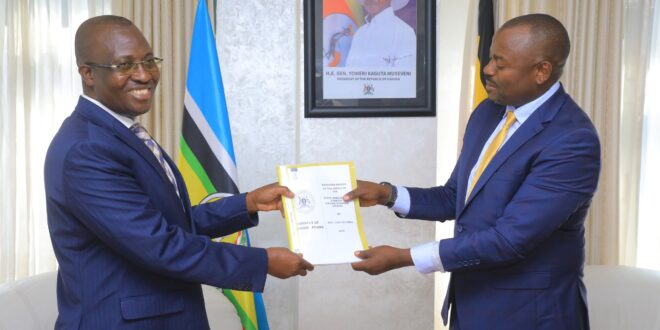
KAMPALA, Uganda — The formal handover of the Office of the Minister of State for Foreign Affairs (Regional Cooperation) from Hon. John Mulimba to Hon. Haruna Kasolo Kyeyune marks more than a routine transition within government. It signals the continuation of a strategic portfolio that sits at the heart of Uganda’s economic diplomacy, regional integration agenda, and engagement with neighboring states.
Held at the Ministry of Foreign Affairs headquarters in Kampala, the ceremony brought together senior officials, and ministry staff under the stewardship of Permanent Secretary Vincent Waiswa Bagiire. While ceremonial in nature, the event offered important insights into the evolving role of regional diplomacy in advancing Uganda’s national interests.
In his remarks, Mr. Bagiire praised Hon. Mulimba’s contribution to strengthening Uganda’s engagement across the East African region and beyond. He particularly highlighted the outgoing minister’s role in spearheading Joint Permanent Commissions (JPCs), a diplomatic mechanism increasingly becoming a cornerstone of Uganda’s bilateral relations. According to the Permanent Secretary, five Joint Permanent Commissions have already been concluded this year alone, creating structured platforms for resolving trade bottlenecks, strengthening political cooperation, and opening new markets for Ugandan products.
In an era where economic growth is closely tied to regional connectivity, such engagements have become vital instruments of foreign policy. For Uganda, a country whose exports depend heavily on regional markets, addressing Non-Tariff Barriers (NTBs) remains a critical diplomatic priority. These barriers, which range from administrative delays and customs procedures to regulatory restrictions, often have a greater impact on trade than tariffs themselves. The emphasis on market access reflects a broader trend across Africa. As implementation of the African Continental Free Trade Area (AfCFTA) gains momentum, governments are increasingly recognizing that diplomatic missions must deliver tangible economic outcomes. Foreign ministries are no longer solely responsible for political relations; they are becoming active facilitators of trade, investment, and commercial diplomacy.
Hon. Mulimba’s tenure appears to have aligned closely with this evolving model, In his farewell remarks, the outgoing minister expressed gratitude to President Yoweri Museveni for entrusting him with the regional cooperation docket and commended the Ministry’s technical team for their professionalism and dedication. He noted that diplomacy often produces results that are not immediately visible to the public but remain fundamental to national development. His observation touches on a reality frequently overlooked in public discourse. Unlike infrastructure projects or social programs that produce visible outputs, diplomatic successes often occur behind closed doors. Negotiations that prevent trade disputes, improve border cooperation, facilitate movement of people, or create favorable conditions for exporters rarely generate headlines, yet their economic and political impact can be substantial. Perhaps one of the most significant lessons shared by Hon. Mulimba was the importance of cultivating personal relationships with regional counterparts. While formal frameworks and treaties remain essential, experienced diplomats acknowledge that trust built through direct engagement often accelerates solutions to complex bilateral challenges.
This principle has been demonstrated globally, Countries such as Rwanda, Kenya, and South Africa have increasingly invested in leader-to-leader and ministerial diplomacy to resolve regional disputes and strengthen economic partnerships. Across the East African Community, informal diplomatic channels frequently complement official negotiations, enabling governments to address emerging concerns before they escalate into larger disputes. The appointment of Hon. Haruna Kasolo Kyeyune therefore comes at a strategically important moment. The region continues to navigate challenges related to trade facilitation, infrastructure connectivity, cross-border security, migration, and economic integration. At the same time, geopolitical competition and shifting global supply chains are creating new opportunities for African economies to position themselves within international markets.
In his acceptance remarks, Hon. Kasolo pledged to build upon the foundation established by his predecessors while working closely with the Ministry’s technical teams to advance Uganda’s foreign policy objectives. His commitment to expanding market access for Ugandan goods and deepening regional cooperation aligns closely with the government’s broader economic transformation agenda. The transition also underscores an important characteristic of Uganda’s foreign policy architecture: continuity. While ministers may change, the strategic objectives of promoting regional stability, advancing economic diplomacy, and supporting regional integration remain consistent pillars of Uganda’s external engagement.
As East Africa moves toward deeper economic integration and greater continental cooperation under the AfCFTA framework, the Ministry of Foreign Affairs will continue to play a central role in shaping Uganda’s competitiveness and influence. The handover from Hon. Mulimba to Hon. Kasolo is therefore not merely a change of officeholders. It represents the passing of responsibility for one of Uganda’s most consequential diplomatic missions ensuring that regional cooperation translates into measurable benefits for businesses, farmers, investors, and citizens across the country. The challenge ahead will be maintaining momentum in an increasingly complex regional environment while ensuring that diplomacy continues to deliver practical outcomes for national development. For Uganda’s new Minister of State for Regional Cooperation, that task begins immediately.
Post Views: 0
Post navigation
Source link