 Xavier Radio Ug News 24 7
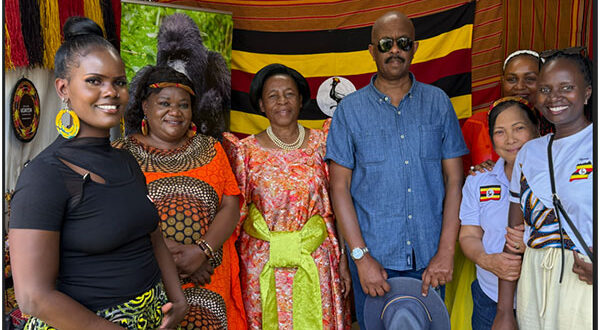
In Gomesi (middle) is Dorothy Huha Samalie, Uganda’s ambassador to Australia, with other Ugandans and officials at the Canberra festival.
Canberra, Australia | THE INDEPENDENT | Multiculturalism sits at the very centre of life in Australia. More than half of the population was born overseas or has at least one parent who was. It is a nation shaped not by a single origin story, but by many journeys converging in one place. Yet while multiculturalism is broadly celebrated, belonging is not always guaranteed.
In 2024, surveys revealed that one in three migrants from non-English-speaking backgrounds experienced racial, ethnic, or religious discrimination in the preceding 12 months. For many migrants, the challenge is not simply settling economically but remaining visible culturally, socially, and emotionally within the national story.
It is within this context that the Multicultural Festival in Canberra takes on a deeper meaning. For Uganda’s diaspora, the festival is not entertainment. It is infrastructure. A place where identity is not negotiated or diluted but expressed openly and collectively.
At the festival, Ugandan communities do more than celebrate heritage; they reconstruct home in public space. Language, food, rhythm, and ritual become anchors of familiarity in an unfamiliar land. The beat of traditional drums, the smell of shared meals, and the easy switching between English and Luganda or Runyankole create an atmosphere that feels both local and transnational.
Ugandan migration to Australia expanded notably from the 1990s, driven by education pathways, skilled migration, and humanitarian routes. Over time, Ugandans have established themselves across healthcare, education, business, faith organisations, and community leadership.
The festival becomes a moment where those contributions are made visible, not in résumés or statistics, but in lived presence. As one Ugandan-Australian attendee reflected, “You live far away, but part of you remains visible. You don’t disappear.”
That visibility matters. Research consistently shows that when cultural identity is affirmed rather than hidden, migrants experience stronger well-being, deeper civic engagement, and a greater sense of ownership in the society they live in. For Uganda’s diaspora, cultural festivals such as Canberra’s create multiple layers of connection.
Preserving ethnic roots
The festival allows Ugandans to pass on cultural knowledge to younger generations born in Australia. Children see their parents’ traditions recognised in public, reinforcing that their heritage is not something to outgrow or explain away.
One parent shared quietly, “For one day, my children don’t have to ask where they fit. They see themselves reflected.” Bonding across migrant communities
Festive goers
While the Ugandan presence is distinct, the festival also brings together migrants from diverse backgrounds. Shared experiences of settlement, adaptation, and resilience create common ground across cultures. Differences remain, but they sit alongside recognition.Bridging with the wider Australian community
For non-migrant Australians, the festival provides an accessible entry point into cultures they may not otherwise encounter. Informal conversations replace assumptions. Curiosity replaces distance. These moments of contact matter: they are where social attitudes shift.
The Ugandan High Commissioner to Australia, Dorothy Samali Hyuha frames this presence not just as cultural expression but as social capital: “Cultural presence strengthens belonging. When people feel seen, they invest more fully in the society they live in. Uganda’s diaspora contributes not only economically but also socially and civically to Australia.”
This investment flows both ways. As Ugandans strengthen their sense of belonging in Australia, they also remain connected to Uganda, acting as informal ambassadors, connectors, and bridges between the two countries.
From belonging to nation branding
Tourism leaders see these moments as foundational to how nations are understood.
The head of the Uganda mission tourism, Tiisa Mugwanya Susan in Uganda explains, “Uganda’s story is one of continuity. Visitors experience a culture that knows itself, is rooted, welcoming, and confident.”
Uganda’s cultural stability, combined with English as an official language and a globally recognised reputation for warmth and hospitality, makes it an accessible destination for Australian travellers and partners. Encounters at festivals often become the first chapter in a longer relationship, with tourism, education, or business following.
Shaping a more inclusive Australia
Cultural festivals are often described as celebrations, but their deeper value lies elsewhere. They are tools for shaping social cohesion. By creating spaces where migrant communities can be fully present and where non-migrants can engage without fear or formality, festivals help counter isolation, challenge stereotypes, and rebuild trust.
When done well, they allow communities not only to participate but also to shape the narrative. They remind Australia that multiculturalism is not a static policy; it is a living practice, renewed every time people are allowed to bring their whole selves into public life.
“Engage with Uganda through culture, tourism, and diaspora-led initiatives. Build partnerships that recognise people as the strongest link between nations. Uganda , where Africa’s future meets its soul.”