 Xavier Radio Ug News 24 7
Advocates say the ruling threatens all freedom of speech and assembly in Uganda
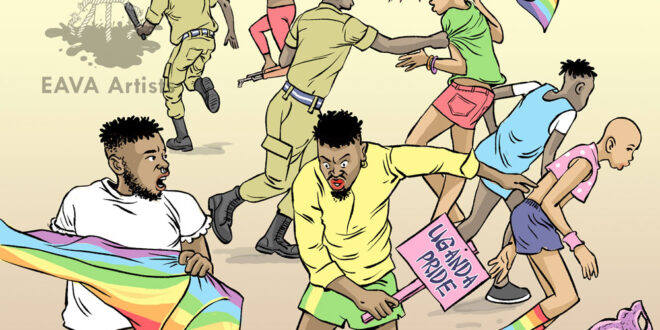
East Africa Visual Artists used this illustration of Ugandan police breaking up a Pride celebration to illustrate its article about latest court ruling declaring an LGBTQ advocacy workshop illegal.
Uganda’s Court of Appeal has dismissed an appeal challenging the 2012 closure of an LGBTQ advocacy workshop organized by Sexual Minorities Uganda and Freedom and Roam Uganda, in what human rights defenders say is a major attack on freedom of speech and assembly.
“By upholding the ban on workshops, the court signals that any civic gathering or community education can be branded a ‘threat,’” says Vincent Kyabayinze, executive director of the activist group East African Visual Artists (EAVA). “This ruling is a direct attack on civic space and we must all be concerned. Because when one group is silenced, the door closes for everyone.”
Edward Mwebaza, the executive director of the Human Rights Awareness and Promotion Forum (HRAPF), which represented the appellants, said the court’s ruling sends a repressive message to concerned citizens.
“You cannot conduct activities, you cannot organise… you cannot resolve issues by holding conversations around issues affecting you, or even building schools, training people in economic empowerment,” Mwebaza says of the ruling.
East African Visual Artists (EAVA) reported on the court case in an article republished in a lightly edited version here:
After 14 Years, Uganda Court upholds workshop shutdown, signaling clampdown on LGBTQ advocacy
In a ruling that has drawn sharp criticism from human rights advocates, Uganda‘s Court of Appeal has dismissed an appeal challenging the 2012 closure of an LGBTQ advocacy workshop, reinforcing limitations on freedoms of expression, association, and assembly for the community. The decision upholds the High Court’s 2014 finding that the shutdown was justified in the public interest to protect moral standards. The ruling upholds the judicial stance of criminalizing everyday advocacy and skills-building efforts.
Simon Lokodo, former Uganda ethics minister.
The case originated from a February 14, 2012, incident at the Imperial Resort Beach Hotel in Entebbe, where Rev. Fr. Simon Lokodo, then Minister for Ethics and Integrity, intervened in a workshop organized by Freedom and Roam Uganda (FARUG) that attendees described as a peaceful session on leadership, project planning, human rights, and advocacy skills.
Lokodo alleged the event promoted same-sex practices, which are outlawed under Section 145 of the Penal Code Act as “unnatural offenses,” citing investigations into FARUG and Sexual Minorities Uganda (SMUG).
The High Court ruled in 2014 that the closure justified to protect moral values. The appellants appealed, arguing that the trial judge improperly resolved criminal allegations via affidavit evidence, relied on speculation, and transformed a human rights enforcement application into a criminal trial.
This latest ruling by the Court of Appeal rejects claims of rights violations under Articles 21 (equality), 29(1)(a) and (d) (expression and assembly), and 38(2) (civic participation) of the 1995 Constitution. The court emphasized the workshop’s “clandestine nature” and materials linked to international LGBTQ groups concluding it encouraged prohibited activities.
Advocacy and Skills Training Now Face Legal Risk
In practical terms, this means gatherings focused on empowering LGBTQ individuals, such as workshops on leadership or rights advocacy, risk being labelled as criminal, exposing participants to arrests, shutdowns, or worse. It aligns with the broader enforcement of the Anti-Homosexuality Act 2023, which imposes severe penalties, including life imprisonment or death for “aggravated homosexuality” and has fuelled a climate of fear, evictions, and violence.
Rights Advocates Condemn the Ruling
Edward Mwebaza, executive director of Human Rights Awareness and Promotion Forum (HRAPF) (Photo courtesy of X)
Edward Mwebaza, the executive director of the Human Rights Awareness and Promotion Forum (HRAPF), which represented the appellants, described the ruling as very unfortunate and biased. He accused the judiciary of adopting a “moralistic approach” based on personal opinions rather than legal and human rights principles, citing similar trends in cases like the SMUG registration appeal and abortion law challenges.
“If judges are also siding with those in the High Court, this shows that this is not really for the benefit of human rights. It is a detriment to the rights that we have so long supported, which the Constitution itself has guaranteed to Ugandans,” Mwebaza says.
Imposing costs on petitioners is meant to curb efforts to defend and promote human rights efforts, he says.
See Also
“That is to stop them from filing further cases, and intimidate people from using those courts to get redress on issues of human rights violations in certain communities, like LGBTQ persons,” Mwebaza says.
Mwebaza is calling for continued resistance, urging fairness and protection of constitutional guarantees.
“The best thing to do is to continue challenging it at the Supreme Court level,” he says, adding that if domestic remedies fail, they would seek justice at regional bodies like the East African Court or UN mechanisms.
“You cannot conduct activities, you cannot organise… you cannot resolve issues by holding conversations around issues affecting you, or even building schools, training people in economic empowerment,” he says of the ruling.
The Court of Appeal decision mirrors earlier judicial positions suggesting that LGBTQ rights to expression and assembly can be limited under existing criminal laws in the penal code and the Anti-Homosexuality Act. The AHA remains in force after Uganda’s Constitutional Court declined to nullify it in April 2024, although rights advocates have appealed the decision to the Supreme Court.
The ruling suggests that skills training or advocacy events could be deemed incitement or conspiracy to commit offenses, or “promotion of homosexuality” under the AHA. Analysts warn that advocacy workshops, community trainings, or even economic empowerment programs could be interpreted as incitement, conspiracy, or “promotion of homosexuality” under the law.
The ruling’s impact extends far beyond the individuals involved. Human rights defenders say it signals a widening legal and social environment where organising, dialogue, and community empowerment efforts face growing risk. For many advocates, the decision underscores an urgent reality: the struggle for equality, civic participation, and constitutional protection in Uganda is far from over.