 Xavier Radio Ug News 24 7
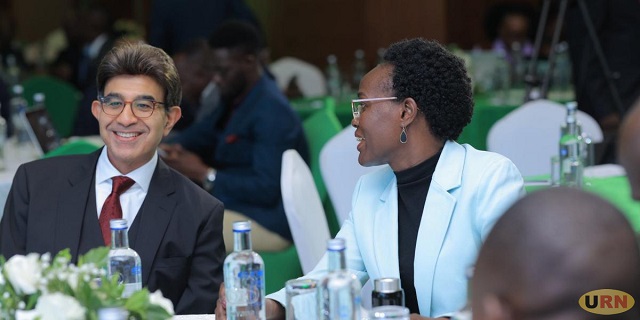
Ahsard Rab shares a light moment with Uganda Development Bank’s CEO, Patricia Ojangole
Kampala, Uganda | THE INDEPENDENT | One of the leading European sustainability experts, Arshad Rab, has stated that Uganda cannot follow the conventional “energy transition” path of developed nations.
Rab, the CEO of the European Organization for Sustainable Development, argued that the global narrative of “transitioning from fossil fuels to clean energy” does not reflect Uganda’s reality.
Delivering a keynote address at Uganda Development Bank’s Reshaping Industries for a Sustainable Economy (RISE) platform in Kampala, Rab argued that the global narrative of “transitioning from fossil fuels to clean energy” does not reflect Uganda’s reality.
“Just imagine a mother cooking dinner over charcoal in a village with no electricity. There is no grid to transition from, no coal plant to retire, only darkness after sunset,” he said. “Uganda is not transitioning from energy abundance. It is emerging from energy scarcity.”
He cautioned that focusing on the language of energy transition often misdirects funds toward pilot renewables, consultancy-heavy programs, and symbolic projects, while the country’s fundamental energy gaps remain unresolved.
“When terminology is misplaced, priorities are misplaced, and ultimately funds are misplaced,” he noted. He called for “energy expansion with intelligence.”
The RISE initiative, he explained, is designed to build systems that power industrialization, agriculture, and small enterprises, rather than simply meeting climate compliance goals.
He seemed uncomfortable with the steps that Uganda has so far taken to transition to a low-carbon future. Uganda’s Energy Transition Plan, which was launched in 2023, lays out a roadmap for Uganda to sustainably develop its energy sector, meet its climate targets, deliver universal energy access, and realise widespread economic benefits.
It sets out an ambitious yet feasible pathway to achieve universal energy access by the end of the decade and a peak in emissions by 2040. The Energy Transition Plan sees solar power as the leading source of low-cost generation.
The analysis, carried out with the support of the International Energy Agency (IEA), shows that implementing this plan would allow Uganda to meet its Nationally Determined Contribution to the Paris Agreement in 2030 and be in a position to reach net zero emissions from its energy sector by 2065.
However, Rab, who is also the Chairperson of the International Sustainability Council, noted that “Developing countries like Uganda are uniquely positioned to build low-carbon systems intelligently from scratch,” Rab said.
He challenged the international framing of energy strategies in Uganda. “The term energy transition was born in developed economies,” he explained.
“It describes the shift of mature, fossil-fuel-based systems, coal plants-built decades ago, gas pipelines spanning countries and continents, transport networks powered by petroleum, toward cleaner alternatives.”
He said in those contexts, the term Energy Transition makes sense because developed countries are replacing one dominant huge system with another that is 100% organic, with no toxic chemicals. For Uganda, he said, it is fundamentally different.
“We are not transitioning from energy abundance; we are emerging from energy scarcity.” At the conference taking place at the Sheraton Hotel in Kampala, it was repeatedly noted that nearly half of Uganda’s population still lacks reliable electricity access, and many rely on biomass for cooking.
He remarked that Industrial growth in Uganda is constrained not by over-dependence on fossil fuels, but by the absence of consistent and affordable power. And yet, he said, energy transition continues to appear in national strategies, shape financing frameworks, and guide global investment flows.
“When terminology is misplaced, priorities are misplaced, and ultimately funds are misplaced,” he warned.
“Attention shifts toward global carbon narratives while local access gaps remain unresolved.” He highlighted the consequences of this misalignment.
“Renewable pilot projects are launched without an operating model that works. Ambitious roadmaps are published while industries continue to rely on diesel generators or suffer from the absence of affordable and reliable energy. This is not a failure of technology. It is a failure of framing. Because when a problem is defined incorrectly, solutions follow the wrong logic.” Rab contrasted the challenges facing industrialized nations with those facing Uganda.
“Industrialized nations must transition. They built energy-intensive economies over more than a century. They now face the gigantic challenge of decarbonizing them. But countries like Uganda face a different mandate. It isn’t transition; they need expansion. Expansion that is clean, yes. Expansion that is climate-conscious, yes. But expansion nonetheless.”
He stressed that priorities for Uganda are clear: universal electricity access, industrial competitiveness, affordable tariffs, productive use of power, and economic transformation. “One cannot transition away from darkness without first switching on the light,” he said.
The centrepiece of his address was the RISE initiative, which he described as a framework for “energy expansion with intelligence.”
Reshaping Industries for a Sustainable Economy (RISE) is an initiative of Uganda Development Bank. The platform enables financial institutions to create demand for sustainable finance by turning key societal, economic, and environmental challenges into transformational business opportunities.
Unlike traditional approaches that chase trends or comply with international buzzwords, RISE begins with diagnosis: what kind of energy system does Uganda need to industrialize, to compete, and to prosper? “RISE does not begin with trendy terminology.
It begins with asking the fundamental question: how do we build a system that powers industries, agriculture, small enterprises, and digital infrastructure?” he explained. “It does not treat energy as a climate compliance exercise. It treats it as economic infrastructure.”
He painted a vivid picture of the consequences of misplaced priorities. “International funding tied to energy transition goals often channels resources toward pilot renewables with no economic basis. Funds flow toward consultancy studies, reporting frameworks, and grant cycles, completely detached from baseload generation or industrial energy infrastructure. The nation pays for something it doesn’t need because it doesn’t even possess the kind of energy infrastructure that can be transitioned. Repeated often enough, the phrase ‘energy transition’ acquires moral authority. It becomes unquestioned. And when language becomes unquestioned, critical examination disappears.”
He suggested that Uganda should stop measuring success by alignment with global terminology and focus on domestic productivity.
“The fundamental question is diluted completely: how do we build an energy system that powers us?” he asked. “How do we build an energy system that powers industrialization, creates jobs, supports agriculture, fuels small enterprises, and raises incomes?”
Uganda, he argued, has a unique opportunity. Unlike industrialized nations, it is not burdened by legacy fossil fuel infrastructure.
“Developing countries are uniquely positioned to build low-carbon systems from the outset precisely because they are not locked into old, polluting infrastructure,” he said. But realizing this potential requires honest diagnosis and deliberate design.
“You cannot prescribe the same remedy to two patients with different diagnoses. A fully developed economy must decarbonize.
Uganda must nourish, must be nourished,” he said, invoking a metaphor that drew laughter and nods from the audience.
In practical terms, RISE aims to integrate generation, transmission, storage, and industrial load planning into coordinated, scalable programs.
“Energy expansion is approached through scattered interventions, and capital becomes cautious. Tariffs remain high. Industry remains constrained. But if energy development is structured as a national pipeline, capital engages. Scale is the magnet for investment. Investors do not move toward isolated assets. They move toward systems,” he said.
He was particularly critical of projects that anchor pricing to survival energy, such as charcoal or wood, rather than industrial competitiveness.
“The objective is not to compete with subsistence energy use. The objective is to deliver affordable, scalable power that drives productivity. When pricing is anchored to the cost of burning wood rather than to the requirements of industrial competitiveness, ambition shrinks. Projects remain limited in scale because they are expensive. But why are they expensive? Because they are structured as isolated assets rather than integrated systems.”
He emphasized the importance of scale and structure in transforming Uganda’s energy sector.
“Small projects are expensive by design; they lack purchasing power, cannot distribute fixed costs efficiently, and struggle to attract long-term capital. But when generation, transmission, and demand are aggregated, unit costs fall, procurement strengthens, financing terms improve, risk spreads across larger portfolios, and investor confidence increases,” he said.
“Electrification is not a peripheral development goal. It is the backbone of industrialization. It is the oxygen of modern agriculture. It is the bloodstream of manufacturing. It is the nervous system of the digital economy. Without affordable and reliable power, every other strategy weakens. With it, everything else accelerates.” He repeatedly underscored that symbolic or fragmented interventions are insufficient.
“When the problem is defined as transition, the solution becomes symbolic. If the problem is defined as scarcity, the challenge becomes an investable business opportunity. Uganda does not need symbolic replacement; it needs scale. Unless the diagnosis is corrected, electrification will remain fragmented, expensive, and slow.”
He used stark imagery to make his point: small solar lantern projects or mini-grids may make headlines, but they do not restructure national energy systems.
Solar lanterns are celebrated as progress. A handful of mini-grids are milestones. Feasibility studies for small wind installations are commissioned, disconnected from broader grid strategy or industrial demand. This is consequential. Aid-driven micro-projects cannot substitute for national infrastructure, and consultancy studies cannot replace megawatts,” he said.
He urged a shift from moralistic debates about energy transition to structural debates about industrialization.
“When the narrative centers around transition, the debate becomes moral. When the narrative centers around industrialization, the debate becomes structural. And structural debates solve real problems,” he said.
He concluded with a call to action: Uganda must build clean, scalable systems intelligently from the outset.
“One cannot transition away from darkness. One must first build the light. And when the light is built with structure, intelligence, and coordinated capital, it does far more than illuminate homes. It powers industries. It strengthens agriculture. It anchors jobs. It fuels growth. This is not a transition. This is the change that Uganda is waiting for.”
****
URN
www.independent.co.ug, https://www.independent.co.ug/uganda-must-build-the-light-before-transitioning-expert-urges-against-symbolic-renewables/