 Xavier Radio Ug News 24 7
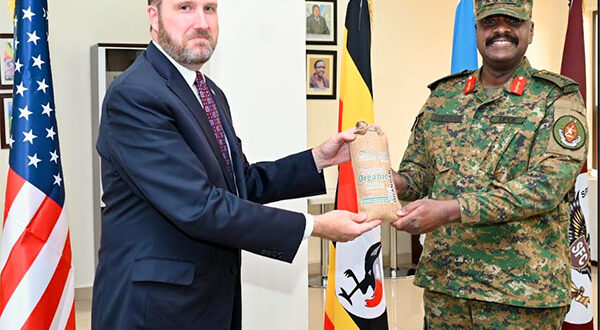
US Ambassador to Uganda William Popp with Gen. Muhoozi in February 2025
What next after top US senator says CDF “crossed a red line”?
Kampala, Uganda | IAN KATUSIIME | A tweet from the chairman of the US Senate Foreign Relations Committee Jim Risch to Gen. Muhoozi Kainerugaba, the Chief of Defence Forces, cast the spotlight on US-Uganda diplomatic relations in the wake of a contentious presidential election where President Yoweri Museveni was elected for a seventh term.
“Commander mkainerugaba has crossed a red line and now the U.S. must reevaluate its security partnership, which includes sanctions, and military cooperation with Uganda,” US Senator Risch posted in response to a series of tweets from Muhoozi alleging a plot by the US Embassy in Uganda in aiding the escape of presidential candidate Robert Kyagulanyi aka Bobi Wine from the country. Muhoozi deleted the tweets amid the backlash.
“The president’s son, and likely successor, cannot just delete tweets and issue hollow apologies. The U.S. will not tolerate this level of instability and recklessness when American personnel, U.S. interests, and innocent lives in the region are at stake,” Senator Risch posted.
Immediately Risch sent his tweet, Muhoozi went into a Twitter hiatus signalling the weight of Risch’s rebuke. Muhoozi had apologised earlier in a tweet saying he was “fed with wrong information” after he announced that UPDF would suspend all cooperation with the US Embassy.
When the CDF emerged from his Twitter break, he responded to Senator Risch, “You can re-evaluate whatever you want as far as our co-operation is concerned but you will never demean and degrade us.”
The exchange between the CDF and the US Senator offered a window into the diplomatic tensions between the US and Uganda.
Since Gen. Muhoozi was appointed CDF two years ago, he has been active on X with threats against political opponents and voicing his opinions on diplomatic issues to the chagrin of Ugandan government officials. Muhoozi is the heir apparent to his father, President Museveni, who has marked 40 years in power.
Senator Risch, a Republican representing the state of Idaho, is a close ally of US President Donald Trump who is serving his second term. A tweet from the chairman of the US Senate Foreign Relations Committee, spelling out possible sanctions on Uganda’s military chief is no ordinary post.
Risch has made sanctions a strong tool of US foreign policy enforcing a strong sanctions regime against countries like Russia, Iran and North Korea.
US Senator Risch
The US Senate Committee on Foreign Relations is one of the most influential in the upper chamber of the US Congress. The committee shapes US foreign policy in terms of legislation and foreign aid. US foreign aid to Uganda ranging from health support to military aid in the form of equipment and training that the US extends to the Uganda Peoples Defence Forces (UPDF) falls under this committee.
This is why the Senator’s statement on Muhoozi was not taken lightly by commentators. US sanctions means a travel ban to the US and freezing of any property held in the country. The sanctions usually have wide ranging political implications as it presents uncertainty when a targeted party is dealing with or travelling to other Western countries which comply with US sanctions for their own interests.
A number of Ugandan Generals are under US sanctions including Gen. Kale Kayuhura, former Inspector General of Police; and Maj. Gen Abel Kandiho, former Chief of Military Intelligence. In 2023, the Commissioner of Prisons Johnson Byabasahija was also sanctioned by the U.S. citing allegations of torture of inmates by Uganda Prison Authorities.
The sanctions have cut across civilians. The Speaker of Parliament Anita Among was placed under US sanctions in 2024 over corruption and embezzlement of public funds.
In April 2021, then US Secretary of State Anthony Blinken announced sanctions on several Ugandan political leaders who were not named for their roles citing their roles in the violence meted out by the state during the presidential election held in Uganda that year.
In December 2023, Blinken revealed a new set of travel bans which he said was an “expansion of the visa restriction policy to include current or former Ugandan officials or others who are believed to be responsible for, or complicit in, undermining the democratic process in Uganda or for policies or actions aimed at repressing members of marginalised or vulnerable populations.” Immediate family members of some of these officials were subject to the restrictions.
The first son has threatened to kill Kyagulanyi, president of the National Unity Platform, who on Jan. 15 contested his second presidential election. Muhoozi ordered the arrest of Kyagulanyi’s bodyguard, Eddie Mutwe, in May last year and he posted photos of a tortured Mutwe in his basement “learning Runyankore” provoking vitriol among the public.
Kyagulanyi’s bodyguard, Eddie Mutwe
Muhoozi also tweeted that his forces had “killed 30 NUP hooligans.” Kyagulanyi has been in hiding since the election and Muhoozi has said the military wants him dead or alive. Muhoozi has ordered for attacks on Kyagulanyi’s home and UPDF soldiers assaulted his wife, Barbie Kyagulanyi, in a raid on their home in Magere, Wakiso district.
The CDF is now caught in the middle of a diplomatic firestorm. In the deleted tweets, Gen. Muhoozi said he had spoken to the US Ambassador, William Popp, to iron out the issue of the embassy allegedly helping Kyagulanyi to flee. It was not the first time Muhoozi was kicking up a storm with the American envoy.
In 2024, Muhoozi gave the Ambassador a 48 hour ultimatum to apologise to President Museveni or leave the country. Muhoozi claimed that the Ambassador had disrespected the President without any evidence.
The situation was resolved and the two men were pictured shaking hands and smiling. Fast forward and the tweeting General has escalated diplomatic tensions.
Muhoozi ally sanctioned
Some close allies of Muhoozi have been caught on the wrong side of US law enforcement. Lt. Michael Katungi, formerly director of global affairs in Patriotic League of Uganda (PLU), Muhoozi’s political party, has a US federal indictment for alleged arms trafficking and drug dealing.
Katungi was charged by a US court in July last year and he was promptly sacked by Muhoozi in a sign of how serious the charges were. Katungi was accused of being part of a conspiracy to illegally supply military-grade weaponry to Mexican drug cartels, and in particular, the Cartel de Jalisco Nueva Generación (CJNG), said to be one of Mexico’s most violent and prolific transnational criminal organizations.
“The weaponry included machineguns, rocket launchers, grenades, night vision equipment, sniper rifles, anti-personnel mines, and anti-aircraft weapons,” the indictment stated.
The US and Uganda have a long history of military cooperation through the US Africa Command (AFRICOM). The cooperation ranges from US special forces training the UPDF, a non-permanent US military bases in Uganda, donation of military equipment and the peacekeeping mission in Somalia where US forces provide logistical and intelligence support to UPDF troops.
But even the military cooperation has shown diplomatic strains in recent years. Gen Dagvin Anderson, Commander of AFRICOM, had a recent trip to East and Horn of Africa to assess security matters where he visited Kenya, Ethiopia and Djibouti but he notably skipped Uganda which is a key partner in the fight against the terrorist group Al Shabaab in Somalia.
Gen. Anderson travelled with US Deputy Secretary of State Christopher Landau. “It was a great opportunity to do a combined visit with our State Department leadership, but also to come out and hear from our partners in the region and also discuss areas of mutual interest,” Gen. Anderson said during a digital press briefing on Feb. 3 as he concluded six months on the job as US AFRICOM Commander.
It was not the first time a US AFRICOM Chief was skipping Uganda on a visit. In 2022, Gen. Stephen Townsend visited the East African region in a nine day tour and looped over Uganda.
In response to questions by The Independent on whether the snub was a calculated diplomatic decision, US Embassy Spokesperson Amy Petersen said “time limitations” prevented Gen. Anderson from visiting more countries. Petersen added, “The United States Africa Command continues to work with African partners, including Uganda, to lead efforts against terrorist threats like Al-Shabaab in Somalia and ISIS throughout west and central Africa.”
For a highly visible army chief like Gen. Muhoozi, the snub from US AFRICOM read like a diplomatic signal of what’s afoot. Gen. Muhoozi has had clashes with Western diplomats going as far as suspending cooperation between Germany and the UPDF after he accused the German ambassador to Uganda of being involved in “subversive activities”.
Muhoozi has not been to the US in a decade. He last set foot in the US in 2015 while visiting a U.S.military training school. At the time, Muhoozi was a Brigadier and in charge of Special Forces Command which provides presidential security and oversees special operations.
Visa bond
In addition to the strained diplomatic relations, it has also gotten harder for Ugandans to travel to the U.S. Starting in January 2026, Ugandans applying for business and tourist visas to the U.S. are required to post refundable bonds of US$15,000 which is way out of what majority Ugandans can afford.
Uganda is one of the countries that was hit hardest by the shutdown of USAID by the Trump Administration early last year. HIV/AIDS, malaria and TB treatment were heavily reliant on US funding in hundreds of millions of dollars per year.
However in December, the US and Uganda signed a 5-year, $2.3 billion (approx. UGX 8.09 trillion) health partnership, with $1.7 billion from the U.S. and $577million from Uganda in counterpart funding.
This deal aims to strengthen health systems, focusing on HIV/AIDS, malaria, tuberculosis, and maternal health while promoting sustainability. But there were concerns over Uganda’s health data sovereignty in the new partnership arguing that it could leave the data in the hands of a foreign power. A source in the health sector summed up the deal. “It’s a different funding mechanism designed to suit their current foreign policy.”
Ambassador Popp stated that the new agreement reflects the doctrine under US Secretary of State Marco Rubio who has stated that “every American dollar must advance shared strategic interests.”