 Xavier Radio Ug News 24 7
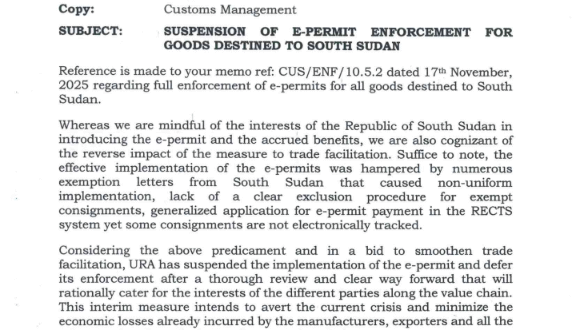
The Uganda Revenue Authority (URA) has launched a high-level investigation into how an explosive internal memo suspending the enforcement of South Sudan’s electronic import permit (e-permit) system was issued — allegedly without proper authorisation and possibly forged by a junior officer.
The memo, dated 21 November 2025 and bearing the name of Commissioner Customs Asadu Kigozi Kisitu, halted enforcement of the e-permit requirement for goods destined for South Sudan. But insiders now claim the directive never came from Kisitu, triggering fears of internal sabotage and a wider cross-border revenue conspiracy.
The scandal is threatening not only Uganda–South Sudan trade relations but also the job of URA Commissioner General John Musinguzi Rujoki, as powerful actors push aggressively to force the controversial system into full operation.
Multiple authoritative sources say the groups behind the South Sudan e-permit rollout are “ready to crush anyone” blocking the system — including Uganda’s top tax chiefs.
The chaos has already derailed a top-level emergency meeting between the two countries’ revenue authorities, leaving traders stranded, cargo stuck at border points, and the region’s busiest trade corridor on the brink of paralysis.
HOW IT STARTED
In September 2025, the South Sudan Revenue Authority (SSRA) introduced mandatory e-permits for all imports entering via Uganda.
On 17 November, URA acknowledged the new system in a brief, loosely structured understanding with SSRA.
But SSRA Commissioner General William Anyuon Kuol escalated matters on 20 November when he issued a sweeping directive ordering:
No cargo entry without an e-permit.
No exemptions unless personally cleared by him.
All exemptions must still be tracked in the RCTS system.
All diverted cargo to undergo revalidation.
Administrative action for non-compliers.
This strict announcement was copied to senior officials on both sides — signalling full and uncompromising enforcement.
URA PUSHES BACK — THEN A CONTROVERSIAL MEMO EMERGES
On 21 November, a memo surfaced from URA “suspending” the e-permit enforcement, citing:
Non-uniform implementation caused by multiple exemption letters from South Sudan.
No clear procedures for exempt cargo.
Some consignments not electronically tracked
Risk of chaos within the regional RCTS system
Disruptions already harming manufacturers and exporters.
The memo ordered the disabling of e-permit functions from RCTS until bilateral talks define a clear path.
However, URA insiders now insist the memo was not authorised and that the signature may have been forged by a junior staffer. This has triggered a full-scale internal probe.
Meanwhile, traders remain confused — with South Sudan insisting on iron-tight enforcement while Uganda signals a total suspension.
CRISIS MEETING
SSRA Commissioner General Anyuon Kuol reportedly made a sudden, unplanned trip to Kampala for an emergency Saturday meeting (22 November). But the meeting collapsed under unclear circumstances.
Multiple sources claim the reasons behind the collapse are explosive, with details expected to shock the trading community in the coming days.
A highly connected South Sudan–associated company, Crawford Capital Ltd, is being whispered as the real driver behind the e-permit rollout.
Key concerns raised: System appears designed more for revenue extraction than trade facilitation
Receipts issued at the border reportedly lack official coding. Some payments allegedly diverted into private accounts. Ugandan enforcement officers operating under unofficial directives.
Traders forced to pay duplicate fees, inflating costs.
Economists warn that South Sudan’s fragile economy cannot sustain unregulated revenue diversion disguised as digital reform.
The unfolding crisis has already triggered:
Major delays along the Elegu–Nimule route.
Rising market prices in South Sudan.
Congestion and confusion among drivers and clearing agents.
Possible violations of East African Community (EAC) trade protocols.
Fears of a mafia-like cross-border revenue cartel.
Trade bodies argue that the e-permit system is not anchored in any regional framework, amounting to a disguised non-tariff barrier.
Traders, civil society and logistics associations now demand answers on: The legal basis of the e-permit.
The role of private companies in its rollout.
Where collected money is going.
Why Uganda is enforcing a non-EAC-recognised system.
Whether corrupt networks in Juba and Kampala are driving policy.
With hundreds of trucks stuck at the border and uncertainty rising, the region waits anxiously.
About Post Author
Post navigation