 Xavier Radio Ug News 24 7
French-Caribbean stylist and celebrity still feels the sting of being targeted with murder music
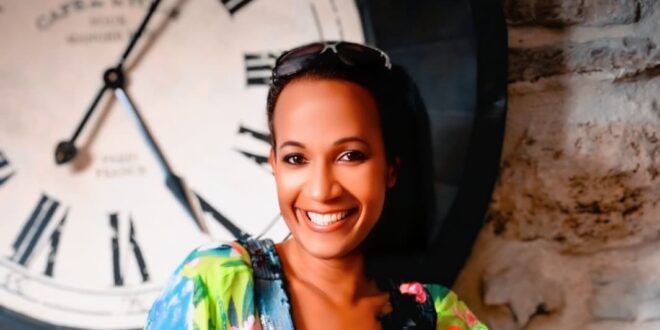
Vincent McDoom was the first Afro-queer icon to appear on French television when he appeared on “La Ferme des Célébrités”, a show broadcast and produced in 2004 by the television channel TF1. (Photo courtesy of @vincent_mcdoom_d.a)
Originally from the Caribbean island of St. Lucia, Vincent McDoom had to break through the glass ceiling as a foreigner, English speaker, black man, and queer person in France. In 2004, at the height of his fame on “La Ferme des Célébrités”, a reality TV show that brought him to the attention of the general public, Vincent McDoom unwittingly inspired a homophobic Caribbean dancehall singer’s murder music.
That Guadeloupean dancehall singer, Krys (Pedro Pirbakas), built his own musical reputation on his hostility to Vincent McDoom as expressed in Krys’s piece “McDoom dead.”
Although that homophobic song was never released on record, it is still available on social media. It’s a hate-filled call for discrimination against the entire LGBT+ community, in particular Vincent McDoom.
Twenty years after a memorable confrontation between the two men on Sébastien Cauet’s show on Nouvelle Radio Jeune in 2006 on the subject of homophobia, the controversy continues. Krys says he has been misunderstood, while Vincent McDoom rejects his opponent’s denials.
Vincent McDoom agreed to speak to Erasing 76 Crimes about the unspoken issues and the latest developments in his controversy with Krys, as well as the broader problems of homophobia in the Caribbean and in the French entertainment industry.
Guadeloupe-born dancehall musician Krys. (Photo courtesy of Deezer.com)
Murder music is a mental burden
Erasing 76 Crimes: In the Caribbean media and on social networks, there has been a lot of commentary and posts about Krys’s feelings and the impact his clash with you had on his career. How did you feel about the release of the song ”McDoom Dead“ in 2004.
Vincent McDoom: I heard about it through threats I received on the internet from people in the Caribbean community. Then, when I heard the lyrics of the song for the first time, I was outraged to find that Krys had thrown my name into the mix to feed the homophobic baser instincts of his fans. However, coming from Saint Lucia, I am familiar with dancehall music; in fact, it was the music of my childhood, because on my native island we often consume products from the Jamaican entertainment industry.
As a result, I was already familiar with murder music and the many controversies surrounding Buju Banton [whose 1992 song “Boom Bye Bye” was an explicit call to kill gay men], except that Krys, by using my name, unlike other dancehall singers, went so far as to put a target on my back. My name appears at least four times in “McDoom Dead,” and it clearly incites hatred and violence against me. It traumatized me.
Erasing 76 Crimes: Why didn’t you file a formal complaint against Krys?
Vincent McDoom: Currently, if I want to, I can still file a complaint, but I haven’t done so in order to avoid sabotaging his career, contrary to what Krys has been saying for 20 years. In that sense, I was magnanimous, but that’s not recognized.
The unfolding of the clash between Krys and Vincent McDoom
Erasing 76 Crimes: What is your version of the clash you had with Krys on Cauet’s show?
Vincent McDoom: In France, celebrities cross paths and meet each other much more often on talk shows than in the Caribbean, and at the time when Krys was doing the rounds of TV and radio shows, I also happened to be in the news as the new presenter of “Rire et Chanteur” and the new host of a reality TV show called “Myriam et les garçons”.
Contrary to the version alleged by Krys’ supporters, when I arrived at the recording studio, I had not been warned that Krys was there. It was not a “setup.” However, I had already heard that his fans had asked him to sing “McDoom dead” in order to whip the audience into a frenzy before his concerts.
So when I saw Krys arrive at the NRJ radio studio, to me he was just a tiny man surrounded by two rather imposing bodyguards. Of course, I wanted to get a closer look at who he was, but when he saw me, he looked me up and down and sized me up. At the time, he was the darling of his entourage and didn’t speak to me for a second. When I realized who he was, I asked for the lyrics to the song to be printed and distributed to all the commentators on the set.
In any case, on a radio show that is filmed and broadcast live, all the guests are treated the same, and as a result, Sébastien Cauet and Cécile de Ménibus had already done their research on Krys, as they do every time they have a celebrity guest. Although the lyrics of the song in question are in Creole, “McDoom Dead” was accessible on the internet in just a few clicks.
So clearly this song was not as underground as Krys later implied. And besides, in this type of show, even if the topic is the latest news about artists, guests are usually prepared to be regularly confronted with everything they have done publicly in the past.
Regarding the exchange with Krys on set, he immediately chose to portray himself as a victim, as he still does today, referring to me and my presence in the media as a problem in the way Black people are represented on air.
I found this painful and particularly guilt-inducing, as it made me the allegory of a broader societal issue, presented as a problem for which I am in no way responsible; whereas in the song in which he insults me, there is no mention of representing diversity.
Under pressure, Krys had to apologize to me, but he refused to do so on several occasions, despite the many people who urged him to seize this opportunity to turn the page. It should be noted that the show even had to be interrupted for several minutes while Krys accused me of wanting to harm his career. It was very tense.
Finally, at the very end of the show, after it had resumed, Krys deigned to apologize to me, which I immediately rejected because it was insincere. Also, throughout the 20 years that followed, his efforts to play the victim proved that I was right. Krys is someone who always thinks he is right and never questions himself.
Vincent McDoom displays his style. (Photos courtesy of Present Image)
The shockwave within the music industry
Erasing 76 Crimes: The Caribbean and diasporic LGBT+ association An Nou Allé, represented by Louis-Georges Tin and David Auerbach-Chiffrin, even issued a press release condemning the fact that Krys had broadcast a previously unreleased song called “Vincent McClown”.
Vincent McDoom: I wasn’t informed about “Vincent McClown”.
However, following the appearance on Cauet’s show, Universal Music, which produced Krys, asked me not to file a complaint and they even considered giving me money to bury the matter. There was even a press release in preparation to “clear” Krys, but I remained firm and categorical and refused to compromise.
Meanwhile, Krys was receiving calls from TV and radio stations inviting him to explain himself about the clash on Cauet’s show, especially since his media tour was set to continue as part of the launch of his album K-RYSMATIK. However, he no longer wanted to continue appearing on TV shows and as a result he was taken off the schedule, forcing his record label to terminate his contract. That is the truth.
This case has had complex repercussions in the music industry, as rapper Diam’s did not continue her artistic collaboration with Admiral T, [Guadeloupean rapper Christy Campbell, who is known for his homophobic lyrics] seven though they had produced a song together called “Les Mains en l’air” (Hands in the Air).
Admiral T, for his part, asked his staff to remove all of his homophobic repertoire from the internet; while through a mutual friend, he asked to meet with me, but that never happened.
On the one hand, I was still reeling from Krys’ accusations, and on the other hand, I had a busy professional schedule at the time. Furthermore, I didn’t know much about the dates when Admiral T was performing in France during his tours.
Meanwhile, in the Caribbean, DJs were using the audio clip of Krys apologizing to me to highlight his hypocrisy and insincere personality. They were allies.
What’s a shame is that Krys subsequently had other opportunities to resume dialogue with me, but he never did.
For example, every year [French chef, television presenter and politician] Babette de Rozières organizes a garden party, and we happened to be seated next to each other, but he always pretended to ignore my presence.
Later, in Royan, France, in a small nightclub, I saw him perform. He recognized me and instantly shot me a dirty look. It never went any further than that.
Today, at 60 years old, if my path crosses Krys’s again, despite our history, I will still go and say hello to him, despite his victim mentality, which suits him very poorly.
Vincent McDoom with comedian Pierre Palmade in 2025. (Photo courtesy of Femmeactuelle.fr)
Erasing 76 Crimes: Why did you think Admiral T wanted to see you? Did he want to mediate between you and Krys?
Vincent McDoom: I don’t know exactly why he wanted to meet me. However, I think, and this is my interpretation, that he felt guilty because he was the one who introduced this type of murder music song to the French West Indies, whereas dancehall had already been firmly established for more than 25 years in the English-speaking Caribbean. Even in my country, Saint Lucia, no dancehall artist has yet performed murder music.
In this context, Krys broke onto the Caribbean dancehall scene after Admiral T, imitating [his approach].
See Also
I also followed from afar the fact that a school [Christy Campbell Elementary School] had been named after him since 2013 in Guadeloupe. To this end, I noticed that he was investing his own money to improve the equipment at this school, serving young people, whereas Krys never did anything like that.
Failing democratic institutions in the Caribbean in the face of homophobia
Erasing 76 Crimes: What did you think of Claudy Siar’s attempt to rehabilitate Krys in December 2006 on his show “Couleurs Tropicales” on Radio France Internationale, as well as the lack of recurring criticism of homophobic Caribbean artists by the media, academics, intellectuals, or politicians, with the exception of the inimitable Louis-Georges Tin, [the Paris-based academic, activist and founder of the International Day Against Homophobia, Biphobia and Transphobia], who presents himself as the prime minister of the African diaspora?
Vincent McDoom: At the time, no one spoke out against everyday homophobia in the Caribbean, with the rare exception of An Nou Allé within the Parisian diaspora, because Afroqueers were used as scapegoats. And there was the culture of “keeping your head down”. It’s a bit like the dynamic around sexual violence, which I was very involved in in Saint Lucia, and I think that as long as we don’t put words to the pain, the violence will continue and attitudes will not change. [Vincent McDoom was raped between the ages of 9 and 13 by a member of his family.]
In the Caribbean, there is a very strong cultural internalization of homophobia, despite marriage equality, and I remember the late [guitarist/singer] Jacob Desvarieux once asking me why I had caused such a fuss about Krys, when it was me who was targeted in the song “McDoom Dead” in very crude terms.
The same goes for [journalist/singer/TV personality] Claudy Siar, who I was very close to. There are reflexes, people want to stifle the issue, they stick together among Caribbean people, but by refusing to distance himself from Krys, it was as if he was endorsing the latter’s comments, explanations, and lies, even though Claudy and I saw each other regularly.
People completely ignore the extent of violence in music, as if I were the only recipient, as a media personality, when young LGBT+ people in the Caribbean also suffered from unfiltered homophobic language at the time.
And sadly, 20 years later, with the broadcast of “Kelly’s dinners” on Jan. 30 on [TV channel] Martinique La Première —named after journalist Kelly Babo — I see that the same dynamics are at work: Krys is allowed to play the victim, to roll out his flawed argument about the diminished and altered representation of Black people that I supposedly embodied to the detriment of other people of African descent.
All this symbolic violence was unbearable for me to hear again, reawakening in me the traumas of the 2000s that I thought I had healed.
The worst part was seeing how journalist Ludivine Rétory didn’t challenge Krys, who was invited to back up his misleading explanations. He presented me as the mastermind of a “setup,” to use his own words, even though he didn’t bother to contact me beforehand to hear my side of the story.
Since then, I have tried to get in touch with her. I contacted her on her cell phone, but neither she nor the teams at Guadeloupe and Martinique la 1ère deigned to allow me to exercise my right of reply. This astounds me, and at the same time says a lot about the pernicious homophobia in the Afro-Caribbean showbiz world, as well as in the media.
In the program, seated around Krys, I did note the presence of a comedian such as Donel Jacks’man, who knows how to speak out when it comes to racism. There was also Miss France 2025, Angélique Angarni-Filopon, and Miss France 2026, Hinaupoko Devèze, but no one spoke up to point out that no shortcut could justify the hateful comments that others and I have been subjected to.
Given the presence of people who have represented France, I had every right to expect a positive reaction, which did not materialize. I am very angry and concerned about the message this sends.
A new queer generation in the Caribbean
Erasing 76 Crimes: Does your clash with Krys merely reflect a legacy of inertia regarding LGBTphobia in the Caribbean and diaspora communities?
Vincent McDoom: Since late 2006, there are no longer any artists singing murder music in the French West Indies, and this protects young LGBT+ people. In this sense, by confronting Krys, I did something as a citizen that the media and local politicians in the West Indies were not doing at all in the 2000s.
If talented artists such as Noam Sinseau, Soa de Muse, and even Jean-Yves Zamor are shining today, I think I played a small part in that as a pioneering Afroqueer personality in the French media.
76crimes.com, https://76crimes.com/2026/03/12/vincent-mcdoom-lifts-the-lid-on-homophobia-in-frances-caribbean-entertainment-industry/