 Xavier Radio Ug News 24 7
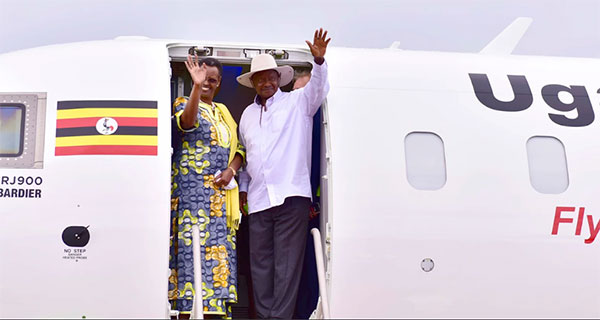
President Yoweri Museveni and First Lady Janet Museveni wave to the crowd during the reception of the newly acquired aircraft a few years ago.
Uganda’s national airline confronts the limits of scale, strategy and state control
COVER STORY | THE INDEPENDENT | Uganda Airlines, the national carrier relaunched in 2019 to reconnect the country to international markets, has temporarily grounded its entire long-haul fleet, a move that has disrupted flights to London and Mumbai and highlighted the fragility of operating ambitious routes with limited resources.
Both of the airline’s Airbus A330-800neo aircraft, the only planes capable of intercontinental service, were taken out of operation last week for unscheduled maintenance. Passengers are being rebooked, flights consolidated, and schedules adjusted.
For a carrier with just six aircraft — four regional Bombardier CRJ900 jets and two wide-body Airbus planes flying over 18 destinations in Africa, Europe, Middle East and Asia— any disruption carries oversized consequences. With both A330s offline, long-haul operations have effectively stalled, leaving the airline exposed not only to financial losses but also to competitive pressures from both regional and global carriers.
Ambition meets operational reality
The relaunch of Uganda Airlines was presented as a national project, designed to serve as more than just a transport service. Proponents, especially government technocrats and politicians, argued that it would bolster tourism, facilitate exports of fish, flowers, and fresh produce, and reduce travel costs for businesses and citizens. It also carried symbolic weight, marking the return of a Ugandan flag carrier nearly two decades after the collapse of the original airline in 2001 at the start of the World Bank/IMF privatisation drive.
“We are not setting up the airline purely for profit,” said the late Kisamba Mugerwa, then chairperson of the National Planning Authority (NPA). “While it may generate revenue in the future, what matters most are its indirect benefits — supporting tourism, facilitating exports of perishable goods, and reducing travel costs for passengers moving in and out of Kampala.”
Part of the appeal of a national carrier was the rapid growth in passenger traffic, which had increased more than tenfold over the past two decades, reaching 1.51 million by 2015. But this demand was spread across more than 20 international airlines operating out of Entebbe International Airport. In 2024, the Entebbe airport recorded 2.2million international passengers compared to 1.9million in the previous year.
Moreover, what was often overlooked is that the previous Uganda Airlines operated from 1976 on government subsidies before it was liquidated by the Museveni government.
The Airbus A330-800neo jets were introduced to demonstrate that Uganda was serious about operating on a global scale. But long-haul aviation is unforgiving. Operating with just two wide-body aircraft leaves little margin for error. Even routine maintenance can disrupt international schedules, a vulnerability that larger airlines mitigate through fleet redundancy and operational flexibility.
President Museveni and First Lady Janet Museveni in the cabin of a new Airbus A330-800neo when services were launched
Uganda Airlines’ latest troubles began in December last year, when numerous flights were delayed or cancelled, leaving passengers stranded in destinations such as Dubai and Lagos.
The past immediate CEO, Jennifer Bamuturaki, told parliament that the airline’s operational difficulties were largely due to its limited fleet, which offered few alternatives in the event of technical issues. This, she said, made it difficult to maintain consistent service.
Leadership challenges and governance questions
Interestingly, the timing of the grounding coincides with leadership upheaval. President Museveni sacked Bamuturaki this month amid criticism from lawmakers and governance experts over financial losses, staffing, and procurement practices. Parliamentary audits and reviews had highlighted weaknesses in oversight and financial management, raising questions about whether Uganda Airlines could scale effectively while maintaining robust governance.
Bamuturaki defended her record, pointing to post-pandemic supply chain challenges and the difficulty of rapidly expanding a small airline. Nevertheless, President Yoweri Museveni, through the Minister of Works and Transport, Gen. Katumba Wamala, as has been the case with other government agencies, bypassed the airlines’ Board of Directors and appointed Girma Wake, 83, the former chief executive of Ethiopian Airlines, as a consultant and an interim CEO. Wake is widely credited with transforming Ethiopian Airlines into Africa’s most profitable carrier and is expected to stabilise Uganda Airlines’ operations.
But the appointment has sparked debate about governance. Analysts caution that a direct presidential appointment risks blurring accountability between the airline’s board and management.
Professor Gerald Kagambirwe Karyeija of the Uganda Management Institute (UMI) told Daily Monitor that overlapping authority could complicate decision-making, while governance researcher Job Kiija warned that perceptions of political interference could undermine the airline’s independence.
“There are issues … that require her to be held accountable. If Wake takes over and sees his predecessor was simply helped to evade accountability, what incentive does he have to perform better?” Kiija told Daily Monitor.
“The current situation is a crisis in itself, not normal corporate governance,” added Dison Okumu, chief executive of the Corporate Governance Institute of Uganda, in comments carried by local media.
The presidency, however, insists Wake’s presence is necessary to protect a key national asset. Uganda Airlines’ struggles with governance are not new.
Last October, the Industrial Court ordered the airline to pay its former chief executive officer, Cornwell Muleya—now CEO of the Industrial Development Corporation in Zambia—Shs 455 million in compensation for wrongful termination.
Museveni met Girma Wake (left), the former CEO of Ethiopian Airlines alongside Mr Robert Kateera at State House on Feb.4, 2026.
In a judgment dated October 24, 2025, Judge Anthony Wabwire Musana ruled that Muleya had been unfairly and unlawfully suspended and dismissed from his role. The court heard that Muleya had served Uganda Airlines for two years, spending nearly 11 months on suspension or forced leave prior to his dismissal. The judge noted that the airline failed to provide a fair oral hearing, denying Muleya the opportunity to defend himself against the allegations.
“Because Uganda National Airlines was unable to show that it respected the claimant’s right to a fair oral hearing, I find his dismissal to be both procedurally and substantively unfair and unlawful,” Judge Musana stated.
The ruling further highlighted that suspensions exceeding four weeks without disciplinary proceedings constitute an unfair labour practice. By the time disciplinary proceedings began, Muleya had already been suspended for six months, in violation of Section 63 of the Employment Act. The judge also noted that failing to serve notice of the oral hearing amounted to procedural unfairness.
Muleya had been appointed chief executive officer of Uganda Airlines in February 2020 on a 12-month renewable contract, having previously served as the airline’s technical advisor. His contract was extended for 18 months on March 1, 2021. However, on April 29, 2021, the Uganda Airlines chairperson issued a notice of leave of absence following allegations of mismanagement raised by the Minister of Works and Transport.
On May 21, 2021, Muleya was suspended for three months pending investigations. The suspension was subsequently extended for another three months, and he was invited to a disciplinary hearing over allegations of mismanagement. He submitted a response to the allegations, but on February 15, 2022, he received a termination notice.
Muleya then petitioned the court, challenging his suspension and termination as unlawful. He argued that he had been denied a fair hearing, subjected to an illegal suspension without proper investigation, and suffered reputational damage as a result.
At the same time, President Museveni appointed Jenifer Bamuturaki—who had previously resigned as the airline’s commercial director amid investigations into management and financial losses—as the new airlines CEO.
Regional and international competitive pressures
In addition, Uganda Airlines’ challenges are also compounded by the competitive environment in Africa and beyond. Regional rivals, including Kenya Airways, RwandAir, Air Tanzania, and Ethiopian Airlines, operate larger long-haul fleets with sufficient redundancy to absorb maintenance disruptions without major operational losses.
Ethiopian Airlines alone runs more than 100 aircrafts, enabling flexible scheduling across Europe, Asia, and the Americas. Kenya Airways’ fleet, which includes Boeing 787 Dreamliners, provides similar resilience, while RwandAir and Air Tanzania, each with 14 and 15 aircrafts, respectively, maintain a mix of narrow-body and wide-body aircraft capable of sustaining international connectivity even when individual planes are grounded.
Former Uganda Airlines CEO Cornwell Muleya (above) CEO Jenifer Bamuturaki who is also now going to be replaced
In contrast, Uganda Airlines’ reliance on just two wide-body aircraft exposes it to operational shocks. Global carriers such as Qatar Airways and Emirates add further pressure, offering multiple daily flights to Africa and Asia with a level of reliability and service that smaller carriers find hard to match.
For premium passengers and corporate clients, repeated disruptions may erode confidence and shift demand toward airlines with proven operational stability.
So far, sections of passengers are now considering alternative airlines instead of using Uganda Airlines for their travels within and outside the region.
Financial and strategic stakes
Uganda Airlines’ grounding underscores the tension between ambition and financial reality. Aviation analysts say long-haul aviation is capital-intensive, and routes can take years to become profitable. So far, the Ugandan government has injected substantial funds to support operations, but repeated disruptions risk placing the financial burden on taxpayers.
Parliamentary committees have asked the airline to outline a clear plan for financial sustainability, while critics warn that recurring losses could strain public finances. Supporters counter that a national carrier offers broader economic benefits, from increased tourism and improved trade logistics to the symbolic value of a flag carrier.
The timing is particularly sensitive as Uganda prepares to expand oil production and industrial capacity. A stable airline is seen as integral to the country’s infrastructure, yet the recent grounding raises questions about whether Uganda Airlines’ growth has outpaced its capacity to manage operational risks.
Lessons for small, state-backed carriers
But the Uganda Airlines’ current predicament illustrates the challenges facing emerging-market carriers. Analysts say ambition must be balanced with operational and financial buffers, and fleet planning must account for maintenance cycles and spare capacity.
Governance structures need clarity, ensuring executive independence while maintaining oversight. Crucially, maintaining passenger confidence is vital, they say, adding that disruptions to long-haul services risk pushing premium clients to competitors with more reliable operations.
Wake’s experience at Ethiopian Airlines is therefore widely seen as a stabilising factor. However, Uganda Airlines, unlike Ethiopian Airlines, faces unique constraints: a small fleet, tighter budgets, and political oversight, conditions that will test Wake’s ability to implement disciplined operational and financial reforms while restoring public and passenger confidence.
Public and passenger reactions
For travellers, the impact is immediate. Flights have been rescheduled, meetings delayed, and international connections missed. Social media commentary has been mixed, with frustration over disruptions tempered by recognition of the complexities involved in operating a young, rapidly expanding airline.
“Why do you let people book and pay for flights even at the last minute, when you already know the planes won’t be able to make the flight! That is absurd and unprofessional. Is maintenance done a few hours to flight departure?” asked Arthur Newton on X. “Just as expected. Business as usual,” added Davis Weddi on X.
Generally, state-backed carriers often face reputational risks not borne by private airlines. Operational failures, even when technical in nature, are frequently interpreted as evidence of political mismanagement, affecting partnerships, investor confidence, and access to financing.
As Uganda Airlines navigates turbulence both on the ground and in the skies, its future will now hinge on whether it can turn the current setback into a lesson. The carrier faces the challenge of proving that a small national airline can survive the rigours of long-haul aviation, compete with both regional rivals and global operators, and continue to play a role in driving trade, tourism, and national pride.