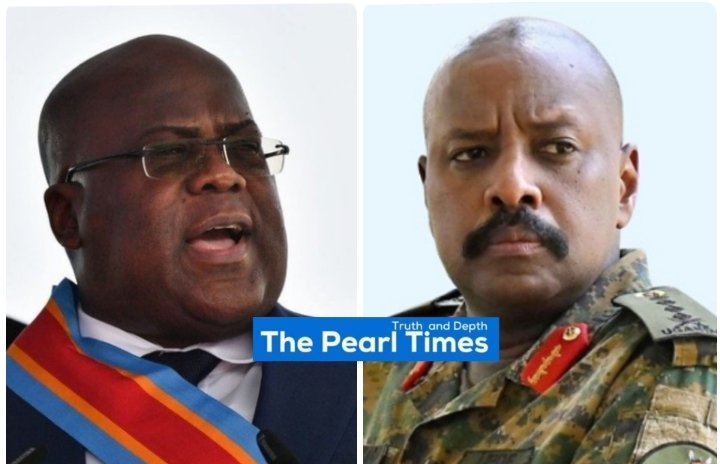

The Uganda People’s Defence Forces (UPDF) has responded to growing diplomatic tensions with the Democratic Republic of Congo (DRC) following remarks by its Chief of Defence Forces (CDF), General Muhoozi Kainerugaba, expressing support for the Front for the Refoundation of the Nation (FRN), a rebel-linked political and military movement operating in eastern Congo.
The Ugandan army has also announced plans to withdraw its troops from Lubero town in North Kivu Province within the next two weeks, handing over responsibility for security to the Congolese armed forces (FARDC).

In two separate statements issued on Friday, November 27, 2026, UPDF Acting Director of Defence Public Information Colonel Chris Magezi addressed both the diplomatic dispute surrounding Muhoozi’s remarks and the planned withdrawal from Lubero.
The statements come days after the Congolese Government summoned Uganda’s diplomatic representative in Kinshasa, demanding explanations over a series of social media posts by Muhoozi concerning the security situation in eastern Congo.
Muhoozi, who also serves as Senior Presidential Advisor for Special Operations and heads the Patriotic League of Uganda (PLU), had publicly endorsed the reported capture of Walikale in North Kivu by the FRN, while declaring that Ugandan troops deployed in eastern Congo would not stand in the group’s way.
In one of his posts on X, formerly Twitter, Muhoozi wrote: “We are opposed to White Mercenaries in the DRC. We have always been opposed to them. We approve the FRN’s capture of Walikale. UPDF will not oppose them. If FRN wastes time, we shall capture it ourselves.”
His remarks also included a declaration of Uganda’s willingness to pursue Allied Democratic Forces (ADF) leader Musa Baluku to his reported hideout in Isiro, in Haut-Uele Province.
In a statement issued on Wednesday evening, November 25, the Congolese Ministry of Foreign Affairs, International Cooperation, Francophonie and Congolese Diaspora said it had summoned Uganda’s head of diplomatic mission in Kinshasa on Tuesday, November 24, to the office of the Minister of State for Foreign Affairs.
Kinshasa expressed displeasure over what it described as grave statements that had triggered a major diplomatic and media incident, undermining the restraint and mutual respect expected between sovereign states.
The Congolese authorities demanded explanations from Kampala, insisting that Uganda clarify its official position and take measures to prevent similar incidents in the future.
The ministry also emphasised that statements made on digital platforms should respect diplomatic principles, national sovereignty and territorial integrity.
Responding to the controversy, Magezi said the joint military campaign against the ADF remained active and that the Ugandan army was determined to pursue the group’s fighters and commanders wherever they sought refuge.
“The joint UPDF–FARDC offensive against the ADF in eastern DRC is ongoing. The mounting pressure has forced the terrorist group to splinter into small groups and flee deeper inland,” Magezi said.
“Working with FARDC, the UPDF remains resolved to pursue ADF remnants and their leaders wherever they take refuge, including in Isiro. This understanding is captured in our Memorandum of Understanding (MOU) of Operation Shujja,” he added.
Magezi also addressed the presence of other armed groups in eastern Congo, including militias he said were allied to the Congolese Government, arguing that their activities had contributed to insecurity among vulnerable communities.
“Secondly, it is also true that there are other negative armed groups operating in the region, some of which are apparently government allied militia forces such as the Wazalendo,” he said.
“These negative militia forces have increasingly mounted attacks against vulnerable communities, massacring women and children such as the Bahema and Tutsi communities in Ituri and the North Kivu region,” Magezi added.
Invoking International Humanitarian Law (IHL), the UPDF spokesperson said Uganda’s military had a responsibility to protect vulnerable communities caught up in the conflict.
“Under International Humanitarian Law (IHL), the UPDF retains the responsibility to extend protection to such vulnerable communities and will continue to do so whenever possible,” he said.
However, Magezi maintained that Uganda supported a peaceful resolution of the conflict rather than the use of foreign mercenaries working alongside armed groups.
“Thirdly, the UPDF, and by extension the government of Uganda fully supports a peaceful resolution of the conflict in eastern DRC among the contending armed groups and the DRC government,” he said.
“We will not support or facilitate foreign mercenary forces that work with violent militia groups to terrorize vulnerable communities in eastern DRC,” he added.
The UPDF statement did not explicitly explain whether Muhoozi’s social media remarks represented a change in Uganda’s official military policy or address Kinshasa’s demand for specific assurances against similar statements.
UPDF Announces Withdrawal From Lubero
In a separate statement, Magezi announced that Uganda would begin withdrawing its troops from Lubero town in North Kivu Province within the next two weeks, transferring security responsibilities to FARDC.
“The Uganda People’s Defence Forces (UPDF) will soon withdraw its forces out of Lubero Town in eastern Democratic Republic of Congo, handing over its security to the Congolese armed forces FARDC,” he said.
According to Magezi, Ugandan troops have operated in the area since January 2025, pursuing remnants of the ADF who had moved into the region to escape pressure from joint military operations in North Kivu and Ituri provinces.
“The UPDF has operated in the area since January 2025 to counter fleeing Allied Democratic Forces (ADF) remnants that sought to escape pressure of joint military operations in North Kivu and Ituri provinces of eastern DRC,” he said.
The announcement did not specify the exact date when the withdrawal would be completed or indicate whether the handover would affect Uganda’s other military deployments in eastern Congo.
It also did not announce the termination of Operation Shujja, which Magezi separately confirmed was still ongoing.
Operation Shujja and Uganda’s Military Presence in DR Congo
Uganda’s military presence in eastern Congo is anchored in a bilateral security arrangement with the Congolese Government aimed primarily at dismantling the Allied Democratic Forces, an armed group with roots in Uganda that established bases across parts of eastern Congo.
The two countries launched Operation Shujja on November 30, 2021, following an escalation of ADF attacks in both Uganda and the DRC. The operation began with Ugandan air and artillery strikes against ADF positions before ground forces moved into the country to conduct joint operations with FARDC.
The campaign has covered parts of North Kivu and Ituri provinces, with the two armies pursuing ADF fighters, dismantling their bases, recovering weapons and rescuing civilians held by the group.
The ADF, which has been linked to the Islamic State, has carried out numerous attacks against civilians in eastern Congo and has also been responsible for deadly attacks inside Uganda.
Lubero became an additional area of UPDF operations in January 2025 as ADF fighters moved deeper into eastern Congo under pressure from the joint offensive.
The withdrawal announcement therefore marks a change in Uganda’s military deployment in the North Kivu town, although the army has maintained that its wider campaign against the ADF will continue.
Who Are the FRN Rebels Supported by Muhoozi?
The diplomatic dispute also brings renewed attention to the Front for the Refoundation of the Nation (FRN), the political and military movement that Muhoozi publicly endorsed in his posts.
The FRN was established on October 12, 2026, in Goma under the leadership of former Congolese President Joseph Kabila, who governed the country from 2001 to 2019.
The movement succeeded the Alliance Fleuve Congo (AFC), a political-military coalition that brought together several anti-government forces, including the March 23 Movement (M23).
The new organisation brought together political figures associated with the former coalition and military structures linked to the M23 rebellion. Among its prominent figures are Corneille Nangaa and Bertrand Bisimwa, who were appointed vice-presidents, while Sultani Makenga became Chief of General Staff.
Its emergence has added another dimension to the conflict between the Congolese Government and armed groups seeking to challenge President Félix Tshisekedi’s administration.
The Congolese Government has characterised the FRN as a continuation of the AFC/M23 alliance rather than an entirely new organisation, maintaining that the change of name does not alter the coalition’s military structures or activities.
The FRN, meanwhile, presents itself as a movement seeking political change and the reconstruction of the Congolese state.
The latest diplomatic disagreement places Uganda’s military leadership in an increasingly delicate position: its forces remain engaged in a joint operation with FARDC against the ADF, even as the country’s army chief has publicly expressed support for a separate armed political movement opposed to the government hosting those same Ugandan troops.
President Museveni has previously apologized for his son Gen Muhoozi Kainerugaba’s controversial posts. (See Details Here and There).