 news TRUSTED NEW
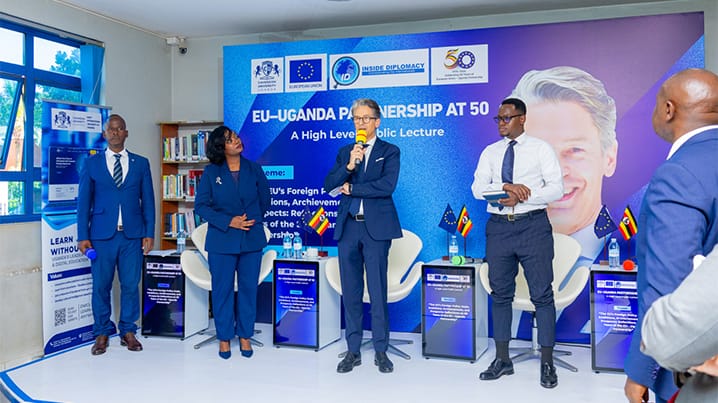
A high-level public diplomacy engagement hosted at Cavendish University Uganda brought into focus five decades of cooperation between European Union and the Republic of Uganda, offering a reflective and forward-looking dialogue anchored in youth engagement, multilateralism, and sustainable development. Convened under the theme “EU Foreign Policy Goals, Ambitions, Achievements and Prospects: Reflections on 50 Years of EU–Uganda Partnership,” the forum underscored the enduring relevance of public diplomacy in shaping informed and inclusive international relations.
Delivering the keynote address on behalf of the Permanent Secretary, Brian Mwesigwa, Minister Counselor at the Ministry of Foreign Affairs, traced the origins of the partnership to the establishment of the EU Delegation in Kampala in 1976. He observed that over five decades, the relationship has remained firmly grounded in dialogue, mutual trust, and a shared commitment to a rules-based international order. The European Union’s contribution exceeding €5 billion in development cooperation, complemented by significant private investment has supported Uganda’s socio-economic transformation, particularly in infrastructure, social services, and post-conflict recovery.
As Uganda’s development trajectory evolves, so too has the character of the partnership. Emphasis has progressively shifted toward sustainable growth, private sector development, and job creation, with particular attention to the country’s youthful demographic. With one of the youngest populations globally, Uganda’s “youth dividend” was highlighted as both a strategic opportunity and a policy imperative. Investments in digital infrastructure, innovation ecosystems, and micro, small and medium-sized enterprises are enabling greater participation of young people and women in the economy, fostering resilience and inclusion. The European Union’s continued support in humanitarian response was equally acknowledged, particularly in light of Uganda’s progressive refugee policy, which has positioned the country among the largest refugee-hosting nations in Africa. EU assistance has strengthened both emergency response mechanisms and long-term resilience among host communities, reinforcing shared principles of solidarity and responsibility.
In his remarks, Jan Sadek offered a candid reflection on the evolving practice of diplomacy in a digital era. He emphasized that modern diplomacy increasingly extends beyond formal channels into public engagement, where transparency, accessibility, and dialogue with citizens especially young people are indispensable. Through digital platforms and open forums, diplomacy is becoming more participatory, complementing traditional statecraft with real-time interaction and public accountability. Ambassador Sadek further reflected on the European Union’s own historical evolution as a peace project rooted in cooperation, integration, and shared governance. While acknowledging contemporary global complexities, he reaffirmed the EU’s commitment to multilateralism and enduring partnerships with regions such as Africa.
The engagement at Cavendish University Uganda thus served not only as a commemoration of past achievements but also as a strategic platform for cultivating the next generation of global actors. As EU–Uganda relations advance, their continued vitality will depend on adaptive diplomacy, inclusive growth, and the active participation of informed and engaged citizens.
Post navigation
Source link