 news TRUSTED NEW
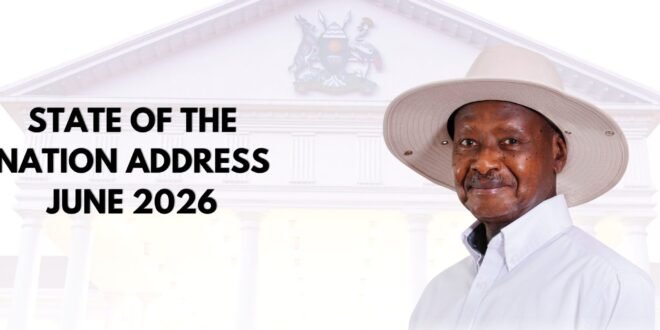
Kampala — President Yoweri Kaguta Museveni’s 2026 State of the Nation Address (SONA) marks a significant evolution in Uganda’s development narrative. While previous addresses largely focused on economic recovery, infrastructure expansion, and sectoral growth, this year’s message carries a stronger emphasis on implementation, accountability, and performance. At its core, the address reflects a government seeking to transition from laying developmental foundations to demanding measurable outcomes from institutions, leaders, and citizens alike. The recurring phrase “No More Sleep” emerged as the defining political and economic message of the speech. However, beyond its rhetorical appeal, the phrase represents a broader governance doctrine centered on productivity, efficiency, and the urgency of translating policy into tangible socio-economic transformation.
Unlike many contemporary policy speeches that focus exclusively on current statistics, the President devoted substantial attention to Uganda’s post-independence economic history. By revisiting the transition from subsistence livelihoods to commercial production, the address sought to place current economic achievements within a long-term national transformation framework. The narrative highlighted the National Resistance Movement’s long-standing emphasis on moving households from subsistence agriculture into the money economy. In doing so, the President linked Uganda’s current development agenda to a broader ideological vision rooted in wealth creation, economic integration, and self-sustaining growth. This historical framing is particularly significant in an African context, where development strategies increasingly seek to balance modernization with locally grounded solutions.
One of the most notable aspects of the address was the emphasis on economic performance with Uganda’s economy is projected to grow by 6.4 percent in the current fiscal year, with expectations of reaching 10 percent growth in the next financial cycle. The government further projects the economy to approach the USD 80 billion mark before the commencement of commercial oil production. These projections position Uganda among the faster-growing economies in Sub-Saharan Africa at a time when many developing countries continue to grapple with inflationary pressures, debt vulnerabilities, and global economic uncertainty. Equally important is Uganda’s attainment of lower-middle-income status, a milestone that government officials have increasingly highlighted as evidence of sustained macroeconomic progress. Yet, as international development experience demonstrates, growth alone does not automatically translate into widespread prosperity. The next challenge lies in ensuring that economic expansion creates quality jobs, strengthens household incomes, and reduces regional inequalities.
Agriculture occupied a central position throughout the address, reflecting its continued importance to Uganda’s economy. The President highlighted the transformation of the dairy industry, growth in coffee production, and increased agricultural commercialization. He also reiterated support for initiatives such as the Parish Development Model (PDM), Emyooga, Operation Wealth Creation, and irrigation expansion. From a policy perspective, the government’s push toward intensive farming, irrigation, and value addition aligns with broader continental priorities under the African Union’s agricultural transformation agenda. However, the long-term success of these initiatives will depend on effective implementation, market access, agricultural financing, and climate resilience areas that remain critical challenges across much of Africa.
Perhaps the most consequential shift in the 2026 address is its strong emphasis on accountability. The President’s criticism of corruption, bureaucratic inertia, and non-performance suggests growing recognition that public investment alone cannot deliver development outcomes without efficient institutions. This focus mirrors a broader trend across developing economies where governance quality is increasingly viewed as a decisive factor in attracting investment and sustaining growth. For Uganda, the message signals an emerging policy transition: from expanding development programmes to ensuring that existing programmes deliver measurable impact. The challenge now lies in translating political messaging into institutional reforms capable of improving service delivery, strengthening transparency, and enhancing public trust.
Another defining feature of the address was its continued emphasis on regional and continental integration. The President reaffirmed support for larger African markets, arguing that domestic demand alone cannot sustain long-term industrialization. This perspective aligns closely with the objectives of the African Continental Free Trade Area, which seeks to create the world’s largest free trade area by participating countries. As global supply chains continue to evolve, regional integration offers African economies opportunities to expand trade, increase competitiveness, and reduce vulnerability to external shocks. Uganda’s strategic investments in transport corridors, rail infrastructure, energy generation, and oil pipelines are therefore not merely national projects; they are increasingly regional economic assets.
One of the more intriguing themes raised in the speech concerns the character of Uganda’s emerging middle class. The President questioned whether new wealth creation is producing a productive national entrepreneurial class or an import-dependent commercial elite. This debate extends far beyond Uganda. Across Africa, policymakers continue to grapple with how to foster industrialization-driven wealth rather than consumption-led growth. The distinction is important because sustainable economic transformation typically depends on productive sectors such as manufacturing, technology, agribusiness, and value-added services rather than solely on trade and real estate.
The 2026 State of the Nation Address presents a government that increasingly views implementation as the next frontier of development. If previous years focused on infrastructure expansion, macroeconomic stabilization, and programme creation, this year’s message emphasizes execution, productivity, and accountability. The address also reflects broader global realities. In an increasingly competitive international environment, economic success is no longer determined solely by resource endowments or policy design. It depends on institutional effectiveness, human capital, innovation, and the ability to convert national potential into measurable outcomes. For Uganda, the coming years will test whether strong growth projections, agricultural transformation programmes, infrastructure investments, and regional integration ambitions can converge into a more inclusive and sustainable development model. For observers across Africa, the speech offers an important case study of how governments are attempting to navigate the transition from economic expansion toward economic transformation.
According to Daily Thinkers assessment, the 2026 State of the Nation Address represents a notable shift from development planning to development execution. Its central message is less about announcing new programmes and more about demanding performance from existing institutions. While economic indicators point toward significant progress, the ultimate measure of success will be whether growth translates into improved livelihoods, stronger institutions, and broader opportunities for citizens. In that regard, Uganda’s next challenge is not simply achieving growth it is ensuring that growth works for all.
Post navigation
Source link