 news TRUSTED NEW
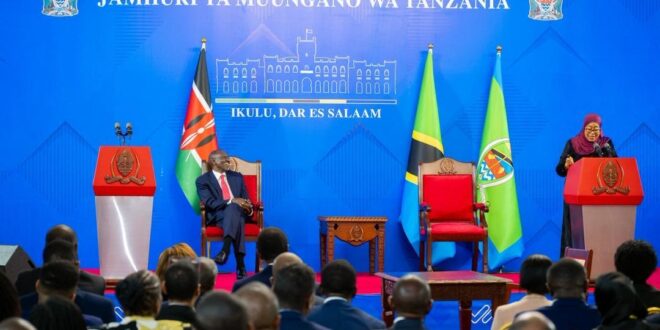
Dar es Salaam / Tanzania— A rare moment of public candour between regional leaders has drawn fresh attention to the complexities of East Africa’s energy ambitions, after Tanzanian President Samia Suluhu Hassan openly pressed Kenyan President William Ruto to clarify remarks about a proposed oil refinery in Tanga. The exchange, which unfolded during a Memorandum of Understanding signing ceremony at State House in Dar es Salaam, underscores both the opportunities and sensitivities surrounding cross-border infrastructure projects in the region. At the centre of the discussion is a plan, first referenced by Ruto at the Africa We Build Summit 2026 in Nairobi, to establish a joint refinery involving Kenya, Uganda, and Nigerian industrialist Aliko Dangote in Tanzania’s coastal city of Tanga.
President Suluhu’s remarks were measured but unmistakably firm. She indicated that her government had not been formally engaged on the refinery proposal prior to its public mention, describing her intervention as a necessary step to ensure alignment between partners. In diplomatic terms, her statement signalled a broader principle: that regional cooperation must be anchored in consultation, transparency, and mutual consent. President Ruto, responding at the same press conference, sought to reframe the proposal as a strategic opportunity rather than a point of contention. He described the envisioned refinery as a transformative investment capable of repositioning East Africa within global energy value chains. By processing crude oil within the region, he argued, partner states could move beyond the long-standing pattern of exporting raw resources and importing refined products at higher cost.
The economic rationale behind the proposal is not without precedent. Across Africa, governments have increasingly emphasized value addition as a pathway to industrialisation, job creation, and fiscal resilience. A refinery in Tanga, proponents suggest, could support downstream industries including petrochemicals, fertilizers, and plastics sectors with significant multiplier effects across manufacturing and agriculture. Geography also plays a role in the argument. Ruto pointed to Tanga’s proximity to the Kenyan port city of Mombasa and its linkage to existing refined products infrastructure as factors that could enhance the project’s viability. From this perspective, the refinery would not only serve Tanzania but function as a regional hub, integrating supply chains across the East African Community.
Yet the exchange between the two leaders highlights a critical dimension often overlooked in large-scale infrastructure planning: political ownership. For host countries, projects of this magnitude carry implications that extend beyond economics, touching on sovereignty, environmental considerations, and long-term development strategy. Public endorsement, therefore, must follow not precede structured engagement.
The engagements reflect a broader tension within African integration efforts, while there is strong political will to pursue joint investments, differences in national priorities, communication channels, and institutional coordination can complicate implementation. In this context, Suluhu’s intervention may be seen less as resistance and more as an assertion of process. Importantly, neither side signalled a breakdown in relations. On the contrary, the tone of the engagement remained constructive, with both leaders emphasizing the potential benefits of collaboration. This suggests that the issue is likely to transition from public debate to technical negotiation, where feasibility studies, financing structures, and governance frameworks will determine the project’s trajectory.
The involvement of private capital, particularly from figures such as Dangote, adds another layer to the discussion. Public-private partnerships have become central to infrastructure development across the continent, but they also require clear regulatory frameworks and alignment with national development plans. Ensuring that such investments deliver equitable benefits will be a key consideration for all parties involved. For East Africa, the stakes are significant. The region stands at a pivotal moment in its energy evolution, with discoveries of oil and gas resources creating both opportunity and urgency. Decisions made now about where and how to invest in refining capacity will shape economic patterns for decades to come.
The Tanga refinery proposal, whether realised in its current form or adapted through negotiation, represents more than a single project. It is a test case for how African states navigate shared ambitions in an increasingly interconnected yet competitive global economy. It also raises a fundamental question: can regional integration move at the pace of political announcements, or must it proceed at the rhythm of consensus-building? In pressing for clarity, President Suluhu has reinforced the importance of the latter. In defending the vision, President Ruto has articulated the promise of the former. Between these positions lies the space where diplomacy, policy, and development must converge. As discussions continue, the outcome will likely hinge not only on economic feasibility but on the strength of trust between partners. In a region where cooperation is both a necessity and a challenge, that trust may ultimately prove to be the most valuable resource of all.
Post navigation
Source link