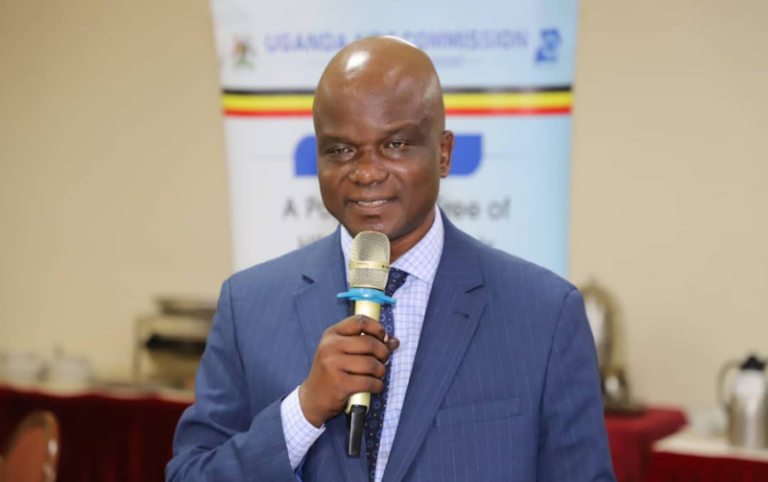
On November 13, I attended journalist Robert Madoi Nabasa’s public PhD defence titled; “Wet Behind Ears?: (De)Constructing Uganda’s Unruly Publics in the Age of Pax Musevenica,” at the College of Humanities and Social Sciences (CHUSS), Makerere University, in Kampala.
Despite his brilliant philosophical answers, one moment caught my attention during cross-examination by Prof Abasi Kiyimba of the department of Literature, who posed a teasing question to the candidate: “Robert, whom does your thesis speak to? Who is your target audience?”
Madoi replied that his PhD thesis was written for his offspring and future generations. He said, half-jokingly: “I have written this thesis to answer my children and grandchildren who will ask me; how did one man rule you for 40 years?”
The entire CHUSS smart room, filled with academics, thought leaders, journalists and students, laughed out loud. I, however, imagined myself as a parent being asked that exact same question by my own children or grandchildren in the future.
While journalist and soon-to-be Dr Robert Madoi has produced a futuristic PhD thesis that will defend his conscience against that inevitable question, I worry that millions of other parents who will still be alive may tremble to answer it.
The year 1986 sounds like yesterday, yet it is now 40 years since President Museveni and his historical Luweero bush war comrades captured state power in Kampala. Four decades in office is far from ordinary; it is substantially longer than any of his immediate post-independence predecessors since 1962 managed.
From his journey as an ambitious boy at Mbarara High School and Ntare School, to the University of Dar es Salaam, to his guerrilla pursuit of power and his long tenure as head of state, Museveni himself is a living political encyclopaedia for generations to study.
Regardless of where one stands across the political spectrum, anyone with a political conscience can draw at least one or two lessons from his trajectory. Whether you admire him or not, what Museveni has done to maintain his grip on power for 40 years and counting is historic, and I prophesize that no one will replicate it in the land of our ancestors.
That is why Madoi’s question lingers; what shall we tell our children about how one man ruled us for over 40 years? Even after Museveni is gone, whenever that may be, those who remain will offer vastly different explanations, and there will certainly be no unanimous answer.
Some will argue he was loved by citizens, while others will insist he was a visionary leader or point to his sophisticated guerrilla leadership and strong-armed forces. Others still will accuse him of ruling with an iron fist, while some will contend that he was far more democratic than Idi Amin.
Inevitably, every parent will be offering their own interpretation. In my own analysis, however, Museveni has remained in power longer than his predecessors because he has deployed a political “Dark Triad” strategy, aided by what he once described in an interview with journalist Andrew Mwenda as the Bible, the AK-47 and the pen.
In psychology, the Dark Triad refers to three overlapping traits; narcissism, machiavellianism and psychopathy, all united by a common core of callous manipulation.
Translated into politics, these traits manifest as a cult of indispensability, strategic manipulation and the calculated use of fear without remorse.
Throughout his more than 40-year tenure, Museveni has leveraged the narrative that “only I can save the nation”, frequently projecting himself as the sole ideological visionary capable of shielding Uganda from the political instabilities and economic setbacks of its pre-1986 past.
Over time, he has positioned himself as the chief consumer of intelligence, shaping his own opposition competitors and the wealthy business class while rewarding loyalty over merit, thereby entrenching a patronage system upon which his presidency thrives.
For any leader seeking to retain political control over the long term, co-opting or neutralising the business class and opposition groups that pose the greatest threat to power is critical.
Undisputedly, in that regard, he has succeeded. Another lesson from this political playbook is timing; knowing precisely when to deploy the AK-47, and when to utilise the media, religious institutions, cultural leaders, the judiciary and the legislature as instruments of influence and state control.
Unlike Idi Amin Dada (President of Uganda between 1971 and 1979), who dispensed with elections altogether, Museveni has conducted elections seven times while remaining in power.
That electoral ritual is part of the reason why the United Nations, the European Union, the United States, the World Bank Group, the United Kingdom and other international actors have often maintained working relations with Kampala despite democratic concerns over his four decades in office.
At the same time, whenever Museveni’s hold on power has felt threatened, critics and human rights monitors have documented how unlawful arrests, torture, enforced disappearances and election-related violence have been deployed to instill fear and reinforce a strongman aura.
Within the logic of the Dark Triad, manipulative skill, political calculation, propaganda and ruthlessness are central to power consolidation, a pattern seen across authoritarian-leaning regimes worldwide.
Therefore, in my view, the answer to Madoi’s haunting question, which the surviving parents of tomorrow will one day have to confront before their children and grandchildren, is straightforward; he masterfully applied a Dark Triad strategy of power retention.
As the years go by, it is all but inevitable that at some point, many Ugandan parents will be asked by their offspring: “Dad, or Grandpa, how did one man rule you for more than 40 years?”
MADOI THESIS AT GLANCE
The silencing of critical voices both during the late colonial and postcolonial periods has imperiled democracy in Uganda.

With the public media hardly in a position to guarantee a steady stream of independent information about public affairs, guerrilla journalism has thrived behind unruly publics using activist tactics to expose underreported issues.
Defining unruly publics as the totality of people who are intentional in their refusal to be bound by conventions of civility, Madoi’s thesis explores the impact of their resistance to, and contestations against, state power both during the late colonial and postcolonial periods.
Typically done outside of traditional media structures, he examines the tools the unruly publics mobilised at two moments in Ugandan history when maladministration cohered with suppression of free expression.
By bringing together the late colonial and postcolonial periods, a provocative inquiry into mobilisation of activism to illuminate issues on the margins set out to identify a knowledge gap.
Drawing majorly on the Foucauldian theory of power, glimpsed within an exploratory design adopted to construct data from attitudes and beliefs of the unruly publics, he melded critical discourse analysis’s analytical power with the contextual data provided by digital ethnography to generate hypotheses for further research.
He argues throughout the thesis that the unruly publics’ counterpower marked by the unorthodox responses that break out of the conventional structures of society is a response to the technologies of power and control.
While the expressive motifs upon which the dissent was predicated in both late colonial and postcolonial periods bear a striking resemblance, the qualitative study generates hypotheses as to why outcomes on either side of 1962 are markedly different.
This study points out that the similarities lay in the use of discourses of freedom and liberalism on the one hand as well as political change on the other hand to denounce the weaponisalion of delivery of peace. It is from the dissimilarities that the hypotheses are generated, with the study ultimately problemalising the absence of a ‘united front’in post-1986 Uganda.
The author is a sustainable development analyst
Related