“L’impunité d’aujourd’hui est le crime de demain.” Today’s impunity is tomorrow’s crime.
With those words, a Congolese human rights activist summed up why the violence in the Democratic Republic of Congo (DRC) keeps coming back.
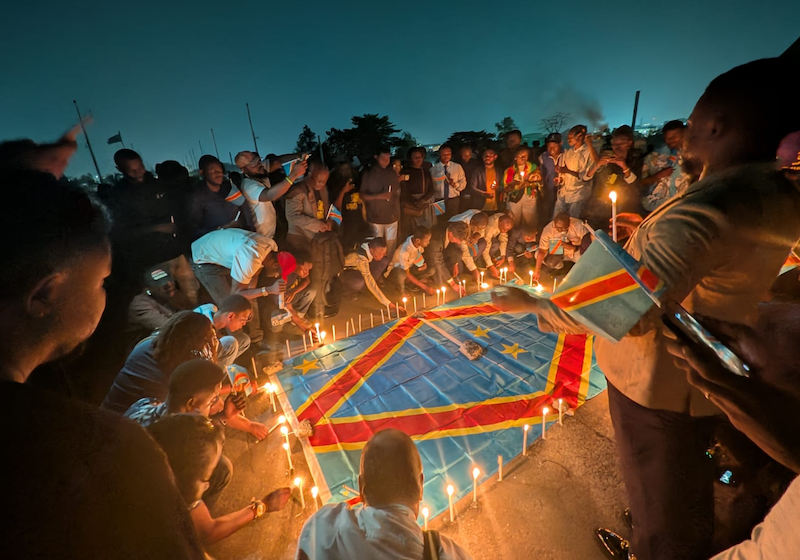
We were standing at the Échangeur de Limete in the heart of Kinshasa, among hundreds of candles flickering around the Congolese flag.
Together with Congolese civil society, we gathered there on 1 October to remember and honour the millions of victims and survivors of decades of armed conflict, and demand justice. The date was no coincidence.
On 1 October 2010, the United Nations published its Mapping Report which runs into hundreds of pages documenting hundreds of atrocities committed in the DRC between 1993 and 2003.
The report called for the establishment of a justice mechanism to hold perpetrators to account. Sixteen years later, this critical accountability mechanism has yet to be realized.
For thirty years, civilians in DRC have been trapped in an unending cycle of atrocities and armed conflicts. Today the spotlight is on M23, the Rwanda-backed opposition group that controls large parts of eastern DRC.
This group has now been joined by former president Joseph Kabila and rebranded as the Front pour la Refondation de la Nation (FRN). But some 200 hundred armed groups operate in the DRC, particularly in the east, and many of them, such as the Wazalendo, which are supported by the Congolese state, kill and abuse civilians, often with impunity.
The conflicts that have gripped the DRC for decades have many drivers, including economic interests and access to natural resources, ethnic tensions, land disputes, and struggles for political power.
Addressing them requires a comprehensive response, and there is no quick fix. But one thing is certain: impunity fuels the violence. Individuals and entities responsible for crimes under international law and other human rights violations still operate and live alongside their victims, patrol the streets, hold public office, and never answer for what they did.
That is why Amnesty International, together with our Congolese civil society partners, chose the commemoration in Kinshasa to launch a new global campaign: 6 million voices for justice for Congo.
More than 6 million lives have been claimed by three decades of armed conflict in the DRC. Through this campaign, we aim to mobilize millions of people in DRC and around the world to raise their voices against impunity and stand in solidarity with the millions of victims and survivors of 30 years of violence.
It is a campaign built on the decades-long struggle of Congolese civil society organizations and human rights defenders for justice for victims and survivors, and on their determination to end the culture of impunity.
This campaign spells out what justice must look like: An internationalized judicial mechanism, such as a temporary hybrid court, with both Congolese and foreign judicial experts (judges, prosecutors, investigators), mandated to investigate and prosecute crimes under international law committed between 1993 and 2003 as documented in the Mapping report and other reports from national and international human rights organizations.
Opening this court to regional and international participation and scrutiny would help build confidence among victims, survivors, and regional and international partners.
This court must be complemented by sustained efforts to strengthen the Congolese civilian justice system, including through legislation establishing specialized mixed chambers within the courts of appeal.
These chambers would be permanent, incorporated into the ordinary courts which already have the mandate to prosecute crimes under international law committed in the DRC, including during recent or ongoing conflict.
They would be composed of judges and prosecutors from the civilian justice system and the military justice system – drawing on the latter’s experience in prosecuting genocide, crimes against humanity and war crimes – offences that fell within military courts’ exclusive jurisdiction under national law until 2013.
This composition could facilitate the transfer of expertise and strengthen the civilian justice system over the long term. These mechanisms must guarantee judicial independence and fair trials and expressly exclude recourse to the death penalty.
These demands are within reach. The DRC government has submitted bills to parliament aimed at establishing both mechanisms. This is a commendable step. Now, parliament must debate and strengthen them by incorporating contributions from civil society, victims and survivors.
Another core demand of Amnesty’s campaign is a guarantee for comprehensive and effective reparation for victims and survivors. The 2022 law on reparations for victims of violence marks an important step toward the recognition of the harm done to millions of people in DRC. But this recognition in law must translate into meaningful redress.
During our visit in Kinshasa in October, Congolese authorities assured us of the inclusive nature of the reparations process, including through the National Fund for Reparations for Victims of Conflict-Related Sexual Violence and Other Crimes against the Peace and Security of Humanity, FONAREV.
However, concerns, including allegations of fund mismanagement, from victims, survivors, and civil society organizations persist. These must be addressed through an independent mechanism that oversees the fund’s work.
Some have questioned whether justice and accountability should be priorities while conflict continues to devastate the country. These concerns are legitimate.
However, we cannot wait for the end of hostilities, which are marked by widespread abuses driven by the long-standing absence of real consequences for crimes under international law, to confront impunity.
Moreover, we deeply believe that addressing impunity will contribute to ending the cycle of violence and crimes under international law. And as efforts to deliver justice, accountability and reparations move forward, all parties to the conflict must protect civilians and ensure safe and unhindered access to humanitarian assistance in conflict-affected areas.
This campaign places the voices of victims and survivors at its heart. Their testimonies are essential to building a collective memory that honours the suffering of individuals and communities across the DRC, they strengthen our shared commitment to ending violence, and they preserve lessons for future generations.
That is why we are calling for 1 October to be designated an annual day of remembrance, reflection and action on crimes under international law in the DRC.
As we embark on this two-year campaign, we recognize the challenges ahead. But we have momentum, and we must turn it into action. Individually and collectively, we have the responsibility to infuse a sense of urgency to move forward on the campaign’s demands, including acting immediately on the two bills in parliament.
It is time to stand firm with the Congolese victims of thirty years of violence. It is time for the Congolese authorities to match words with deeds. It is time to push for justice.
“We seem to be stuck in ‘Back to the Future’, again and again,” we heard on 1 October at the Échangeur de Limete, from people who have fought for justice for decades. It is time to break the cycle.
Join the campaign, sign the petition, add your voice to demand justice for the victims and survivors of the conflict in the DRC.
Authored by
- Herve Delmas Kokou, Executive Director, Amnesty International Cote D’Ivoire
- Lucia Masuka, Executive Director, Amnesty International Zimbabwe
- Wies De Graeve, Executive Director, Amnesty International Belgium – Flemish
Related