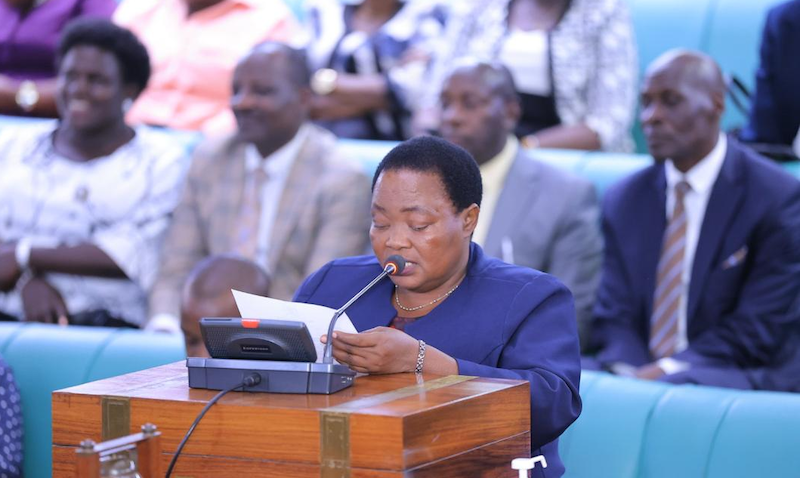
The Prime Minister Robinah Nabbanja has ordered the Uganda Revenue Authority (URA) to review its enforcement following complaints that traders are being subjected to repeated checks on goods that have already been cleared, causing unnecessary delays and disrupting business.
Nabbanja told parliament on Thursday that some traders had encountered situations in which one URA team cleared their consignments, only for another team to intercept the same goods at a subsequent roadblock.
She said the overlapping operations caused unnecessary delays and frustration among business people who had already fulfilled their customs obligations.
“I have directed URA to review the deployment of its enforcement teams so that traders who have complied can have their goods released faster,” Nabbanja told MPs.
The Prime Minister attributed the proliferation of enforcement operations partly to efforts to curb tax evasion involving merchandise entering Uganda through informal channels, often in smaller consignments that are difficult to track.
She said some traders pay taxes in Kenya before transporting goods into Uganda in fragmented loads, including luggage carried on buses, motorcycles and three-wheeled tuk-tuks, making it difficult for authorities to establish whether the appropriate taxes have been paid.
“Uganda was losing tax revenue on those consignments,” Nabbanja said.
President Yoweri Museveni is expected to meet URA officials and other enforcement agencies on Monday, November 23, to discuss the challenges, signalling heightened government attention to the growing tensions between traders and tax authorities.
The complaints come amid a nearly week-long shop closures and industrial action by Kampala traders, organised under the Kampala City Traders Association (KACITA) and other groups, who have protested what they describe as excessive taxation, prolonged customs clearance delays and aggressive enforcement practices.
Traders have particularly objected to the tax regime governing imported textiles and garments, arguing that the combined cost of taxation and customs procedures is making formal trade increasingly difficult and undermining their competitiveness.
Government has urged traders to suspend their protests as Cabinet considers their concerns, including proposals to review textile taxation and harmonise Uganda’s tax treatment with that of other East African Community (EAC) partner states.
Uganda applies the EAC Common External Tariff alongside domestic taxes, including Value Added Tax (VAT) of 18 per cent on taxable imports and import withholding tax, generally levied at 6 per cent in applicable cases.
Traders contend that the cumulative tax burden, compounded by customs valuation practices based on the weight of imported garments, makes formal importation through Uganda more expensive and incentivises some businesses to route merchandise through neighbouring countries.
The government, however, argues that smuggling and the undeclared movement of commercial goods erode revenue, disadvantage compliant businesses and undermine efforts to protect domestic industries under the Buy Uganda, Build Uganda (BUBU) policy.
The enforcement challenge extends beyond textiles, with URA conducting operations along border corridors and inland routes to intercept undeclared merchandise and prevent revenue losses associated with informal trade.
Although estimates of losses from smuggling and illicit cross-border trade have previously run into hundreds of millions of dollars annually, the specific revenue losses linked to the small-load trading practices cited by Nabbanja were not disclosed during Thursday’s parliamentary sitting.
Related