 news TRUSTED NEW
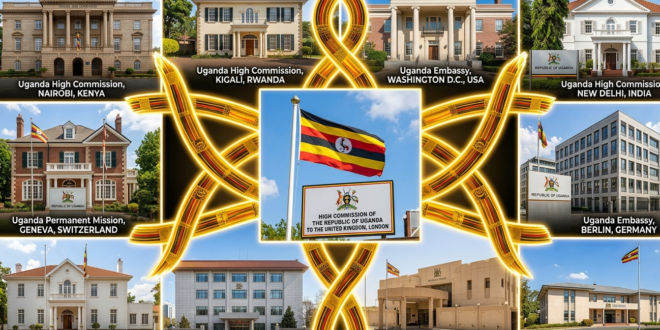
Kampala, Uganda — In recent months, Uganda’s diplomatic missions abroad have increasingly found themselves at the centre of online publications, commentary, and public debate. Allegations ranging from financial mismanagement and administrative inefficiencies to operational underperformance have circulated widely across digital platforms, often drawing public attention to missions in cities such as London, Malaysia, Brussels, Roma, Pretoria, Abu Dhabi, Abuja, Washington, D.C. Kinshasa, Berlin, Copenhagen, Ottawa, and Beijing among others.
Some of these claims appear linked to concerns raised within the Auditor General’s 2025 report, which reportedly highlighted performance gaps, accountability concerns, and institutional weaknesses across certain foreign missions. Yet beyond the specifics of individual allegations some verified, others speculative the wider national conversation now raises a more strategic question: what happens when a country’s international image becomes collateral damage within internal institutional contestations? This question matters particularly for Uganda at a time when the government is actively pursuing economic transformation through Economic and Commercial Diplomacy (ECD) under the Tenfold Growth Strategy. Across foreign missions, diplomats are increasingly tasked not only with political representation, but also with attracting foreign direct investment (FDIs), tourism partnerships, export markets, technology transfers, and strategic business relationships capable of supporting Uganda’s long-term development ambitions.
In this environment, perception itself becomes a form of economic currency, global investors, development partners, and multinational corporations often assess countries not only through economic indicators, but also through institutional reputation, governance narratives, and international media visibility. This explains why national branding is rarely built overnight, it is accumulated gradually through years of diplomacy, policy consistency, investor confidence, and strategic communication. Yet reputational damage can spread globally within hours through a single viral publication or sustained negative narratives online.
Uganda already faces persistent challenges within global governance and corruption perception rankings. While such indices may not always capture the full complexity of national realities, they continue to influence investor psychology, sovereign credibility, and international business decisions. In competitive investment environments, perception gaps alone can redirect opportunities toward alternative destinations. This is why discussions surrounding Uganda’s diplomatic missions require careful balance between accountability and national interest.
Public scrutiny of institutions is legitimate and, in many respects, necessary within modern governance systems. Transparency, oversight, and responsible journalism remain essential pillars of institutional credibility. If irregularities exist within public offices, they must be addressed through lawful processes, audits, reforms, and administrative accountability. However, the growing culture of sensationalized publication particularly when allegations remain unverified or selectively amplified can produce unintended national consequences extending far beyond individual office bearers.
Within diplomatic and policy circles, there is increasing concern that some narratives risk weakening confidence in Uganda’s international representation precisely at a time when the country is seeking to strengthen external partnerships and economic positioning. Diplomats posted abroad function not merely as individuals, but as custodians of national image. When missions become consistently associated with controversy rather than opportunity, the broader country brand inevitably absorbs the damage. The timing of some of the recent public narratives has also generated speculation within political and diplomatic circles. With Uganda approaching expected appointments and possible reshuffles across several sectors including diplomatic and ministerial positions questions have emerged over whether some of the intensified public criticism may intersect with internal competition, institutional lobbying, or positioning for future appointments.
Whether such assumptions hold merit or not, the broader risk remains the same: when institutional reputations are weakened through prolonged public battles, the eventual damage often outlives the individuals involved. A diplomat may leave office, an ambassador may be recalled, a posting may change but rebuilding confidence in a country’s institutional credibility can take years. This reality is particularly important for countries within emerging economies where investment attraction remains heavily dependent on confidence, predictability, and strategic perception management. Nations competing for capital, tourism, and international partnerships increasingly understand that reputation management is now inseparable from economic policy itself.
For Uganda, the challenge therefore is not whether institutions should be questioned, but how such scrutiny can occur without undermining broader national interests. Constructive criticism should ideally contribute toward institutional strengthening, reform recommendations, and policy improvement rather than feeding cycles of reputational erosion that external audiences may interpret as systemic instability. Equally important is the need for stronger strategic communication from institutions themselves. In the absence of timely clarification, verified information, and transparent engagement, speculation often fills the vacuum. Public trust is strengthened not through silence, but through credible communication and visible accountability mechanisms.
Uganda’s diplomatic missions remain central pillars within the country’s Economic and Commercial Diplomacy agenda. Their effectiveness directly affects trade promotion, tourism marketing, diaspora engagement, investment outreach, and bilateral cooperation. Strengthening these institutions therefore requires a long-term approach rooted in professionalism, performance evaluation, institutional reform, and coordinated national messaging. Ultimately, countries do not compete globally through headlines alone. They compete through confidence. And in international diplomacy, confidence is built slowly, carefully, and collectively but it can be weakened very quickly when national institutions become arenas of sustained public demolition rather than strategic improvement.
Post navigation
Source link