 news TRUSTED NEW
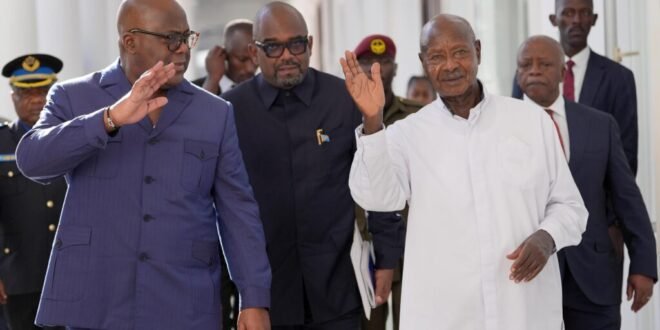
Entebbe/Uganda-The official visit of H.E. Félix Antoine Tshisekedi Tshilombo, President of the Democratic Republic of the Congo (DRC), to Uganda on May 11, 2026, has marked a defining moment in the evolving strategic partnership between Kampala and Kinshasa. Held at State House Entebbe, the high-level engagement followed the successful conclusion of the 9th Session of the Uganda–DRC Joint Permanent Commission (JPC), a bilateral framework increasingly emerging as one of the most consequential diplomatic mechanisms within the Great Lakes region. Against a backdrop of persistent insecurity in Eastern DRC, shifting regional geopolitics, and growing economic interdependence within the East African Community (EAC), the summit underscored a broader reality: Uganda and the DRC are no longer engaging merely as neighbors, but as strategic partners shaping the future of regional stability and economic integration.
The Joint Communiqué issued after the bilateral meeting reflected a multidimensional agenda grounded in security cooperation, infrastructure development, trade liberalization, energy collaboration, and institutional coordination. More importantly, it signaled a deliberate effort by both countries to transition from episodic cooperation toward structured and long-term regional partnership. At the center of the discussions remained the fragile security environment in Eastern DRC, where armed groups continue to threaten civilian populations, economic activity, and regional peace. Both Presidents commended the progress achieved under Operation Shujaa, the joint military offensive launched by the Uganda Peoples’ Defence Forces (UPDF) and the Armed Forces of the Democratic Republic of the Congo (FARDC) against the Allied Democratic Forces (ADF) and other destabilizing armed groups.
The operation, initially viewed through a purely military lens, has increasingly evolved into a broader regional stabilization effort aimed at restoring civilian confidence, reopening transport corridors, and enabling economic recovery in conflict-affected areas. Importantly, the leaders reaffirmed that sustainable peace in Eastern DRC cannot rely solely on military action. They reiterated support for African-led diplomatic initiatives under the African Union framework, while emphasizing the complementary roles of regional mechanisms such as the International Conference on the Great Lakes Region (ICGLR) and the Regional Oversight Mechanism (ROM). Their dual leadership positions within these institutions place Uganda and the DRC at the center of ongoing efforts to coordinate regional responses to instability, displacement, and cross-border insecurity. The continued alignment between Presidents Yoweri Kaguta Museveni and Félix Tshisekedi reflects a growing understanding that instability in Eastern Congo carries direct implications for trade, migration, investment, and security across the wider region.
Infrastructure as a Pillar of Economic Integration
A major highlight of the communiqué was the emphasis placed on infrastructure connectivity as a catalyst for economic transformation and regional integration. The two leaders expressed satisfaction with the progress of the strategic Kasindi–Beni–Butembo road project, a critical transport corridor expected to significantly improve trade flows between Uganda and Eastern DRC. For years, poor road infrastructure has constrained commerce, increased transport costs, and limited access to regional markets. The modernization of cross-border infrastructure is therefore being viewed not simply as a construction initiative, but as a strategic investment in regional competitiveness. The communiqué further directed the immediate removal of Non-Tariff Barriers (NTBs) and the simplification of customs procedures at key border points including Mpondwe and Goli. These measures are expected to facilitate smoother movement of goods and people, reduce delays for traders, and strengthen the implementation of the East African Community Common Market framework. In a notable diplomatic development, the DRC also committed to fast-tracking a reciprocal visa waiver arrangement for Ugandan citizens following Uganda’s 2024 decision to waive visa requirements for Congolese nationals. Once implemented, the visa reciprocity framework is expected to deepen business mobility, tourism, cultural exchange, and people-to-people relations between the two nations.
The leaders also focused on cooperation within the resource-rich Albertine Graben, particularly around the sustainable management of transboundary ecosystems such as Lakes Albert and Edward. Environmental sustainability featured prominently in discussions as both governments acknowledged the need to balance resource extraction with ecological preservation. Beyond environmental concerns, the communiqué highlighted opportunities for joint ventures in hydrocarbons, cross-border electrification, and industrial energy cooperation. Energy collaboration is increasingly being recognized as essential to unlocking industrialization, agricultural value addition, and regional manufacturing growth. Experts argue that coordinated energy planning between Uganda and the DRC could significantly expand electricity access in border communities while positioning the region as an emerging industrial corridor within East and Central Africa.
Institutional Outcomes of the 9th Joint Permanent Commission
The 9th Session of the Joint Permanent Commission concluded with the signing of multiple Memoranda of Understanding (MoUs) spanning trade, ICT, transport, public administration, and export promotion. Among the most notable agreements was a partnership between the Uganda Free Zones and Export Promotions Authority and the Congolese Agence Nationale de Promotion des Exportations aimed at strengthening export coordination and market development. Additional protocols on digital connectivity, administrative cooperation, and search-and-rescue operations demonstrated the increasingly comprehensive nature of Uganda–DRC relations. The institutionalization of these agreements reflects an effort to move beyond symbolic diplomacy toward measurable implementation. To reinforce accountability, both leaders directed the immediate establishment of a Joint Permanent Committee of Experts tasked with overseeing implementation timelines and monitoring progress across sectors.
As the 9th JPC concluded, attention shifted toward implementation and continuity, the decision to convene the 10th Session of the Joint Permanent Commission in Kinshasa in May 2028 signals a commitment to sustained engagement and long-term policy coordination. For Uganda and the DRC, the communiqué represents more than a bilateral agreement. It reflects a broader regional vision centered on security cooperation, economic interdependence, infrastructure modernization, and African-led diplomacy. At a time when the Great Lakes region continues to navigate complex geopolitical and developmental challenges, the strengthening partnership between Kampala and Kinshasa may increasingly shape the trajectory of peace and integration within East and Central Africa. The success of this strategic partnership, however, will ultimately depend not on declarations alone, but on implementation, institutional discipline, and the ability of both governments to translate diplomatic commitments into tangible outcomes for their citizens.
Post navigation
Source link
